Data analytics is a quintessential facet of the collection planning process for brands and retailers. Fashion players are increasingly seeking out data analytics and acknowledging the benefits it can bring to inventory management, profitability, consumer targeting, and more — but not all data analytics are equal.
What are data analytics in fashion?
There are three chief types of data analytics often found in the fashion industry, guiding brands in their decision-making.
- Descriptive analytics: Involves summarizing data to explain what has already happened. This can be anything from past sales data, stock, or consumer habits.
- Predictive analytics: Predicts what is likely (or not) to happen in the future. This method uses historical data to identify future patterns using statistics and algorithms, from predicting consumer behavior to demand.
- Prescriptive analytics: Advises on possible future outcomes. In other words, this approach attempts to guide decisions on the future.
As our relationship with data changes and we discover new, innovative technologies, data analytics is progressing rapidly. The pandemic particularly gave rise to the importance of data analytics for the fashion industry, because it suddenly became more crucial than ever before to adapt to the present and plan for the future, notably in the case of planning future collections. Overnight, fashion brands and retailers were faced with understock and overstock, product assortments that had become no longer desirable, and marketing campaigns and brand identities that were no longer cohesive with shifting consumer values. So what part can data analytics play for brands and retailers?

The state of data analytics in fashion
The COVID-19 pandemic marked a decisive moment for the fashion industry, accelerating the need for data intelligence, AI-driven solutions, and smarter management systems. According to McKinsey (Source : Fashion report), fashion businesses equipped with strong data analytics tools and artificial intelligence technology outperformed others, proving that data-driven strategies now define success in the global retail market.
During this period, offline store sales dropped by nearly 80%, while online shopping and digital retail channels became a lifeline for brands and customers. In Europe, traffic to the top 100 fashion websites increased by 45% in just one month, highlighting how customer preferences and buying habits evolved in real time. This shift forced businesses to rethink their systems, inventory management, and product design processes.
McKinsey revealed a growing divide within the fashion industry:
- Digital & analytics leaders, generating 30–40% of total sales online, integrated analytics and machine learning across their value chain, aligning every team around data and trend insights.
- Laggards, companies with less than 20% online sales, relied on outdated systems, slow decision-making, and limited technology adoption, losing ground to faster, smarter competitors.
In this new era, fashion data analytics helps retailers predict trends, optimize inventory, and understand customer preferences in real time. McKinsey estimated that unsold stock from the Spring/Summer 2020 season reached €140–160 billion worldwide — proof that better forecasting, prescriptive analytics, and AI-based management tools are essential to balance supply and demand.
Today, the future of the fashion industry depends on its ability to build and scale data-driven businesses that connect design, marketing, pricing, and store operations through the use of artificial intelligence. This is where Heuritech helps: by combining AI trend forecasting, machine learning, and market intelligence, we enable fashion teams to design better products, manage inventory more efficiently, and make informed business decisions, turning data into a competitive advantage for every brand.

The optimal data analytics for collection planning
In the past, teams involved in collection planning have relied largely on descriptive analytics to inform their decisions. Sales data on a certain pair of sneakers from last Winter, for instance, would often inform the product design, assortment quantity, and marketing decisions for the same or similar pair of sneakers in the next Winter collection.

But today, predictive analytics is the most efficient way to select which trends to include or exclude in future collections, in which assortment, and for which consumer segments. AI-based trend forecasting is one form of predictive analytics which provides future trend behavior, from geography to market potential. Let’s have a look at one product in particular to better understand the applications and benefits of this form of predictive analytics.
A closer look at sneakers through the lens of data analytics
Sneakers are one of those products that are always trending — but everything from the shape, to the color, to the texture, seems to change year in, year out. Luxury, sportswear, and footwear brands certainly never rest on their laurels when it comes to creating the next pair of sneakers, because this product requires attention to the market and evolving consumer desires. For this reason, AI-based trend forecasting is particularly useful for sneakers.
Predictive data analytics can be helpful for different teams within a fashion brand:
- Designers: Back their intuitions with data so they can create desirable products
- Merchandisers: Have a quantitative guide when planning assortment categories and quantities
- Marketers: Know which consumer segments to target and during which seasons to communicate certain trends
- United: Align teams through the same language of data
But how? With image recognition technology. It is an area of artificial intelligence that focuses on recognizing specific items — such as clothes or shoes — in pictures. Evidently, this technology can recognize fashion trends on social media images by product type and features, including colors, patterns, textures, and shapes. With the help of algorithms, the relevance of a trend is defined through 4 sets of criteria:
- Past behavior
- Magnitude
- Forecasted upcoming growth
- Adoption rate
Designing a product aligned with brand identity and customer expectations
Let’s focus on a specific sneaker case study. Our client wanted to anticipate the future performance of sneakers for their Summer 2025 collection. On top of our Market Insights platform, our client used the Product Ranking to identify the top-performing sneaker styles. Thanks to the data provided, they can know how to choose or avoid certain styles that are losing or gaining desirability to meet customer demand and increase sales.

Leveraging Heuritech’s trend forecasts, the brand identified clear opportunities within the retro and running sneaker segments for Summer 2025.
Data analytics finds the match between brand’s DNA and product positioning
First, it is important to identify the trend’s behavior. Is it fast-growing, rapidly declining, stagnating, seasonal? Does the company have time to release its product before the adoption rate declines? When the right sneaker model is selected and launched at the right time, commercial success is within its grasp and brand positioning is reinforced.
- Warm tone retro trainers were predicted to increase by +29% visibility in the US
- Retro basketball sneakers were predicted to decrease by -11% visibility in the US
- Matte leather retro running sneakers were predicted to increase by +7% visibility in the US
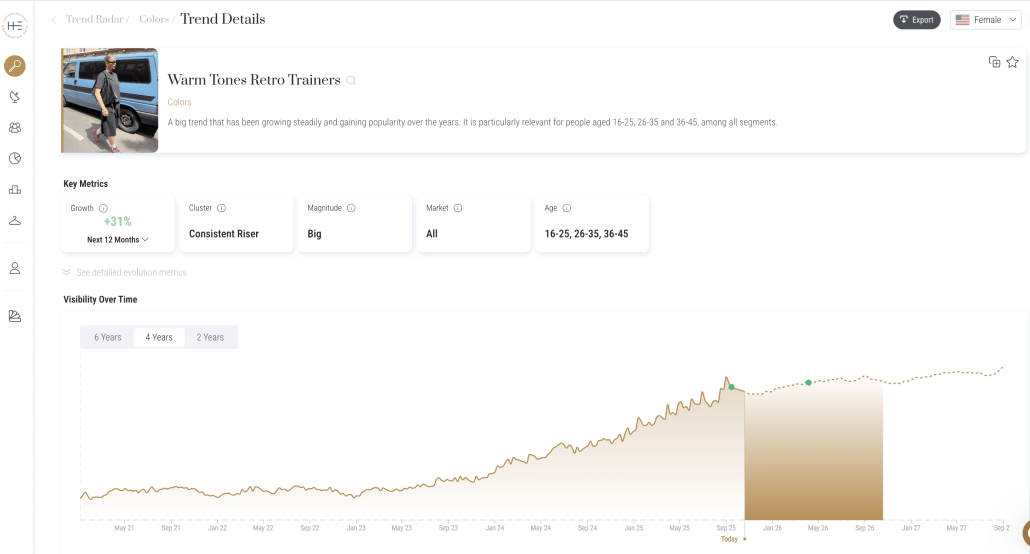
What these numbers mean is that compared to the same season the year prior, a trend undergoes an evolution in visibility of the given percentage during the season of interest. A trend’s potential market demand — in other words, its magnitude — must be taken into account, too, because this helps determine assortment quantity as to avoid under or overstock. Additionally, the high season is worth noting because it indicates the optimal launch time for a certain trend. In this case, our client knows to launch Matte leather retro running sneakers in the Fall, specifically in September.
In our case, our client decided to create 2 designs:
- Retro trainers: the brand opted for a retro trainer in scarlet red (+22% forecasted growth) paired with a gum sole. The upper featured subtle stitching and a low-profile silhouette, with 80s-inspired aesthetic.
- Running sneakers: our client designed a lightweight running sneaker in matte leather. Featuring a sculpted sole, mesh tongue, and leather overlays in greige tones (+27% forecasted growth in the US), the design also incorporated lace-up details, inspired by our Sporting Charm theme. Reflective accents and minimal branding added versatility for both sport and streetwear settings.
Finally, before launching their marketing campaign, our client checked that the style was aligned with their customer target, for instance:
- Edgy: People with bold and distinctive style
- Trendy: Fashionable people looking for the latest styles
- Mainstream: People looking for safe clothing choices
Our client’s target was edgy consumers. As it turns out, our data determined that the retro trainers appeal most to edgy & trendy consumers, while running sneakers had a more global appeal. With that knowledge, brands can adjust their marketing campaign and target a whole range of consumers while making sure to do a specific campaign for their target, in that case, trendsetters.
Conclusion: Predictive data analytics changing the fashion game
In order to launch a sneaker which will most appeal to consumers, fashion brands require:
1. An overview of the shoe market
2. Identification of different sneaker styles among top market trends
3. Sneakers trend that:
- Are a good match for their brand DNA and product positioning
- Are rising
- Are adopted by their target audience
AI-based trend forecasting is the predictive analytics method giving brands and retailers a vision of their present and future market and customers.