Understanding the fashion calendar is essential for any industry professional. More than just dates on a calendar, fashion seasons structure when collections are designed, shown, and sold, shaping everything from creative planning to retail strategies. With Spring/Summer, Autumn/Winter, Resort, and Pre-Fall, this calendar is built to keep pace with consumer demand, global markets, and the fast-changing rhythm of the industry.
What Are Fashion Seasons?
Fashion seasons are the fundamental framework structuring the global fashion industry. A “fashion season” refers to a specific period in the calendar when new clothing collections are designed, showcased, and brought to market. This system originated to synchronize creativity with consumer demand and business cycles, allowing brands to introduce novelty and drive sales at regular intervals.
Traditionally, the industry revolved around two main seasons: Spring/Summer (SS) and Autumn/Winter (AW or FW). These collections set the pace for designers, retailers, and consumers, dictating when new trends appear and old ones fade. Over the past decades, two more collections have become central: Resort/Cruise and Pre-Fall, also known as “inter-seasonal” or “transitional” collections. Their rise reflects changing lifestyles, global travel, and the need to maintain consumer engagement year-round.
As fashion historian José Teunissen explains, “Every six months, fashion presents itself as a moment where the spirit of time is captured in a moment of absolute beauty.” This rhythm of renewal is both an engine for innovation and a practical tool for inventory and merchandising strategies.

A comprehensive calendar highlighting the main fashion seasons, their corresponding fashion weeks, and in-store arrivals for 2025–2026
The Four Key Fashion Seasons and Their Role
Spring/Summer (SS)
Spring/Summer (SS) covers the period from January to June. Spring is January to March and Summer April to June. The Spring/Summer season represents a celebration of lightness, freshness, and renewal. Collections are typically showcased at fashion weeks in September of the previous year and arrive in stores from January to March. The focus is on breathable fabrics like cotton and linen, vibrant colors, and silhouettes that offer comfort and movement — think dresses, blouses, shorts, and swimwear. For many brands, Spring/Summer is the moment to capture attention with bold prints and standout pieces. As seen, for example, in Louis Vuitton SS26 collection, that brought visual sharpness and sporting tradition to the Summer at Lord’s theme, featured timeless motifs with a clean, collegiate sensibility.
Autumn/Winter (AW or FW)
Autumn/Winter (AW) covers the period from July to December. Autumn spans July to September and Winter October to December. Autumn/Winter brings an emphasis on warmth, layering, and texture. Collections are shown at fashion weeks in February/March and hit stores between July and September. The palette turns towards deeper hues, and materials like wool, cashmere, and technical blends become dominant. As highlighted in our recent FW ’25 Women’s Fashion Week Report, outerwear, leather, lace and boots take center stage. AW is often the most lucrative season in terms of revenue for luxury brands, driven by higher-priced items and the gifting period.

Resort/Cruise
Resort (or Cruise) collections were created for affluent clients vacationing in warmer climates during winter months. Today, they are mainstream, serving a global audience seeking newness beyond traditional seasons. Presented in May and delivered to stores from November, Resort collections mix relaxed silhouettes, travel-friendly fabrics, and a playful spirit. For brands like Chanel, Resort shows are major PR events, often staged in exotic locations. Strategically, Resort keeps the retail floor fresh and extends the sales calendar between major drops. To get more information, you can read our article on swimwear trends.
Pre-Fall
Pre-Fall acts as a bridge, helping brands transition from summer to autumn. Typically shown in May or just before FW presentations, Pre-Fall hits stores in late summer. These collections blend lighter and heavier pieces, catering to global markets with different climates. Pre-Fall is key for keeping inventory fresh and for international retailers who must adapt to local weather variations. Many brands see Pre-Fall as an opportunity to test new silhouettes and generate early buzz before the main FW launch.

Image source: Acidsiiia Pre-Fall 2025
The Fashion Calendar: How Does It Work?
The fashion calendar runs several months ahead of meteorological seasons. Collections are shown to buyers and media well before reaching stores. This lag is vital for production planning, buying, and global logistics — a collection presented in September may not hit the shop floor until January or February.
The calendar is also adapted by region. For example, a collection delivered in August may suit autumn in Europe but must be balanced for tropical markets where climate and holidays differ. For global brands, managing this timing is a complex logistical and creative challenge. At the same time, fashion’s tempo is transforming. A growing number of brands—from Gucci to Prada and Saint Laurent—are increasingly embracing a seasonless model, moving away from rigid Spring/Summer and Autumn/Winter drops in favor of collections designed for longevity and year‑round relevance. This evolution reflects a broader demand for sustainability: fewer markdowns, reduced overproduction, and a shift toward capsule wardrobes built around timeless pieces rather than fleeting trends.
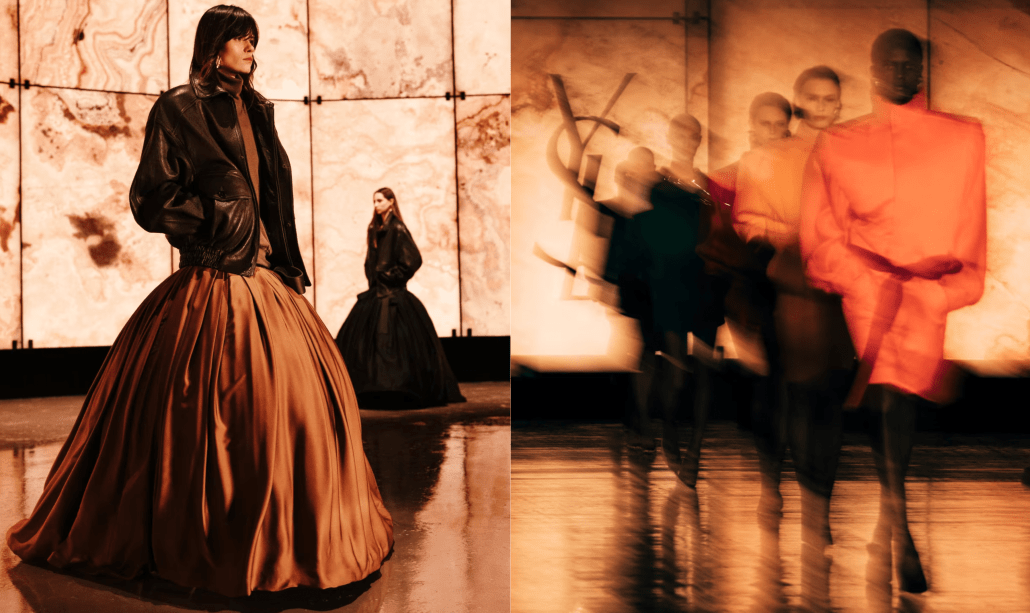
Image source: Saint Laurent FW’25
Fashion Weeks and the Industry Machine
Fashion Weeks in New York, London, Milan, and Paris are the cornerstones of the fashion calendar. Held twice a year for women’s ready-to-wear, these events set the global agenda for trends, press coverage, and retail buy-ins. Beyond the “big four”, cities like Shanghai, and Copenhagen, have growing influence, reflecting fashion’s international reach. Brazil, for instance, is considered as an emerging hub for luxury and fashion brands.
For professionals, Fashion Week data is gold. Buyers place orders, editors spot trends, and brands secure media attention that can drive sales for the upcoming season. Increasingly, digital shows and livestreams have made these events accessible worldwide, broadening their impact.
Challenges & Evolution: Fashion Seasons in a Changing Industry
Disconnect Between Fashion and Weather
A frequent criticism of the fashion calendar is its disconnect from real-life seasons. As Giorgio Armani famously stated, selling winter coats in August or linen dresses in February often makes little sense to consumers. This mismatch can hurt full-price sell-through and lead to early markdowns, impacting profitability (cf. FashionUnited, NYT).
That’s why brands need access to real-time market trends, to understand what consumers want, when and where, and to adjust collection deliveries accordingly.
Fast Fashion, Digital Acceleration & Seasonless Models
Digital disruption and the rise of fast fashion have challenged the old system. Brands now drop new collections continuously, responding instantly to demand (“see now, buy now”). Social media, direct-to-consumer models, and global logistics have enabled seasonless approaches — collections can launch at any time, not just in sync with the traditional calendar.
Practical Insights: How to Adapt Your Strategy to Fashion Seasons
For brands and retailers, understanding fashion seasons isn’t just theory — it’s operational. Successful companies align their collection development, buying, and marketing calendars to maximize freshness and minimize excess inventory. Leveraging data-driven trend forecasting (such as Heuritech’s AI insights) can help anticipate consumer shifts and optimize the timing of product drops, markdowns, and reorders.
Turning Fashion Seasons into Strategic Advantage with Heuritech
In a world where the rhythm of fashion is dictated as much by global climate shifts as by fashion week runways, navigating seasonal calendars has become both a creative and operational challenge. For professionals, the key isn’t just to follow the calendar, it’s to anticipate it. This is where Heuritech becomes a game-changer.
Heuritech’s AI-powered platform enables brands to align their creative and production cycles with real-time market expectations, bridging the gap between the runway and the street. By analyzing millions of images from social media monthly, combined with proprietary algorithms, Heuritech identifies which silhouettes, colors, materials, and details seen at Fashion Week are most likely to resonate with consumers in the months and markets ahead.
This predictive lens allows brands to refine their seasonal collections with confidence, from Spring/Summer to Pre-Fall, region by region, accounting for variations in climate, consumer behavior, and retail windows. For example, a trend spotted on the runway in Paris may peak earlier in Japan than in Europe, or resonate differently across North America and Latin America. With localized trend forecasting, Heuritech helps brands adapt their drop schedules, product mixes, and inventory strategies for each season and geography.
Heuritech’s Fashion Week Reports go one step further: they don’t just summarize catwalk trends, they contrast them with actual consumer momentum. This comparative analysis helps professionals differentiate between what’s a creative signal and what’s a commercial opportunity. Take the recent resurgence of asymmetry: while it dominated the runway, Heuritech’s data revealed it would gain traction only in select markets, and not before the following season. This kind of insight is essential for brands aiming to reduce overproduction and optimize their time-to-market.
By placing demand prediction at the beginning of the collection cycle, Heuritech enables fashion businesses to structure their seasons with greater precision. The result? More targeted assortments, fewer markdowns, and a more sustainable model, where every piece is backed by real consumer insight.In a fast-changing industry, Heuritech transforms the traditional calendar into a forward-looking tool, one where data fuels creativity, and every season becomes an opportunity to be right on time.
Smarter Seasons with Heuritech’s Predictive Intelligence
In today’s accelerated, always-on market, success lies in pairing creative vision with real-time intelligence. AI-powered platforms such as Heuritech have become indispensable allies, analysing millions of social images monthly to quantify emerging colours, fabrics and silhouettes and to forecast their trajectory with more than 90% accuracy. When these data-driven insights are plugged into the design calendar eight to ten months before launch, brands can fine-tune assortments for each region, secure production slots with confidence, and minimise overstock and markdown risk, all while advancing sustainability goals through smarter, demand-led manufacturing.
By closing the loop between the traditional SS, AW, Resort and Pre-Fall drops and the predictive power of Heuritech, fashion businesses turn the calendar from a constraint into a competitive advantage, unlocking collections that land at exactly the right moment, for exactly the right consumer, every season.