For a long time, it was commonly said that fashion trends circle back every two decades. In the industry of before, twenty years was enough time for a trend to rise to popularity, fade away for long enough to be forgotten, and return again with a modern twist.
While the 20-year cycle remains true to an extent, the advent of innovative technologies and social media has drastically condensed the life cycle of trends today. Styles from every decade make appearances at seemingly random moments, and a multitude of styles can be popular at the same time. Design and merchandising technologies have greatly reduced the speed-to-market, and social media makes it so trends rise and fall overnight.

Trends today also originate from myriad sources, including celebrities and influencers, runways, textile manufacturers, social media, music, and more. Their appearance and disappearance are calculated by designers, but also by outside parties like stylists and trend forecasters. A trend may rise to popularity for one reason and fall out of favor for another. Trends are an at times unpredictable phenomenon, but certain behaviors remain true. Indeed, the life cycle of a trend consists of five stages:
- Introduction: A new trend emerges, typically from high-fashion runways, influential designers, or grassroots movements. At this stage, the trend is adopted by a niche audience and exists in limited quantities.
- Rise: The trend gains visibility and traction, often thanks to celebrities, influencers, and stylists. It starts appearing across media and begins to reach a wider, trend-conscious audience.
- Peak: The trend reaches its height of popularity, becoming widely available across major retailers and embraced by mainstream consumers. Luxury brands often move on at this point to maintain their cutting-edge positioning.
- Decline: Oversaturation sets in. Consumers grow tired of seeing the trend everywhere, prompting brands to phase it out or discount remaining stock.
- Obsolescence: The trend fades out of mainstream fashion, no longer considered current. However, it may later reappear in a reinterpreted form, fashion is cyclical, after all.
1. A new fashion trend is introduced
The first stage of a trend’s life cycle is initiated when the new style is introduced. This can be a silhouette, color, pattern, fabric, and more. During this stage, the origin of the trend typically finds itself at the hands of a major brand, designer during the on-season of Fashion Week or a cultural event.
On December 5th 2024, Pantone announced Mocha Mousse (17-1230) as the color of the year 2025. Following the announcement, the color exploded in popularity and is now considered a Consistent Riser, medium magnitude trend by Heuritech’s Fashion trend forecasting platform. It is expected to continue to grow, with a forecasted 9% visibility increase worldwide for the next 12 months.

Another example is the Bottega Venetta Green Kelly boom. While not all new trends rise to such impressive popularity, it goes to show that when a major brand makes the introduction, there is often a higher chance of a trend finding success among other high-fashion and luxury brands before it trickles down to retailers and fast-fashion brands.
New trends can also be introduced by grassroots styles, like the rise of Bloke Core, a fashion aesthetic inspired by 90s British football culture. Initially emerging on TikTok and Reddit, this trend gained traction through vintage jersey styling and retro sneakers, driven by edgy Gen Z consumers. And like so often during the introduction stage, the visibility of a trend is born from a niche target audience, either high-fashion or edgy consumers.

This is also the reason why trends at this stage exist in small quantities at only a few retailers, because mass production only comes once a trend’s relevance is assured by a significant amount of consumers. It’s also important to note that new trends don’t always take off; sometimes, they are introduced and then retracted if enough consumers don’t catch on.
2. The rise of a fashion trend
The second life cycle stage is a trend’s rise to popularity, in which a style evolves from simply “new” to “trendy”. Today, this often happens with the help of celebrities and influencers who popularize a style either by paid promotion or genuine appreciation. Stylists and media strategists often play a big role in this form of popularization, calculating which influencer will wear what.
A phenomenon unfolded in 2025 when Beyoncé, with her album Cowboy Carter, and fashion influencers such as Devon Lee Carlson, championed the rise of the Cowboy, Western‑inspired aesthetic. Sharing looks that mixed rhinestone cowboy hats, denim-on-denim ensembles, bootcut jeans, and fringe jackets on TikTok and Instagram, they redefined the aesthetic with a glamorous, modern twist. In 2025, according to Heuritech data, embroidery cowboy boots recorded a 16% visibility increase in the European market compared to 2024. Demand for suede jackets (+61%), sequined denim (+40%) and chocolate Cowboy boots (+45%) also saw big gains.

The influence of celebrities and influencers is undeniable.
Understanding the pathway of trends from one geography to another is crucial. The interconnected world of social media and global fashion events plays a pivotal role in this cross-cultural exchange. As celebrities and influencers adopt and flaunt these styles, their impact transcends national borders, reaching audiences worldwide.
The power of social media ensures that fashion trends, once exclusive to one region, swiftly become a global phenomenon, captivating audiences and shaping style preferences across diverse cultures.

Celebrity-to-mass market: Beyoncé re introduces cowboy aesthetic and mass market follows
Equally responsible for trend diffusion, as evoked above, is the copycat phenomenon. We saw with the platform heel how high-fashion trends also propagate through copying, in which bridge and fast-fashion brands iterate the trend themselves for a wider customer base.
In spring and early summer 2025, items like rhinestone cowboy hats, sequin-studded fringe jackets, and bootcut denim appeared almost instantly in collections from PrettyLittleThing, Boohoo, and Nasty Gal, each offering their own affordable spin on the luxe rodeo aesthetic. This democratization of style kept the trend momentum high from celebrity stages to high streets.
By mid‑2025, the cowboy-core wave had fully reached mainstream shopping arenas. The fast-fashion version of copycat culture not only amplifies celebrity-led trends, it makes them accessible to a broader consumer base within weeks.

Cowboy boots flooded all fast fashion stores after Beyoncé Cowboy Carter announcement
3. The life cycle peak
The peak stage is where a trend reaches the climax of its popularity among a mainstream audience. Most major retailers now carry the trend and render it accessible to all consumer types, often at lower prices than during the increase stage, and most luxury brands no longer carry the trend as a result. This is a peculiar time in a trend’s life cycle, because the length of its peak is rather unpredictable.
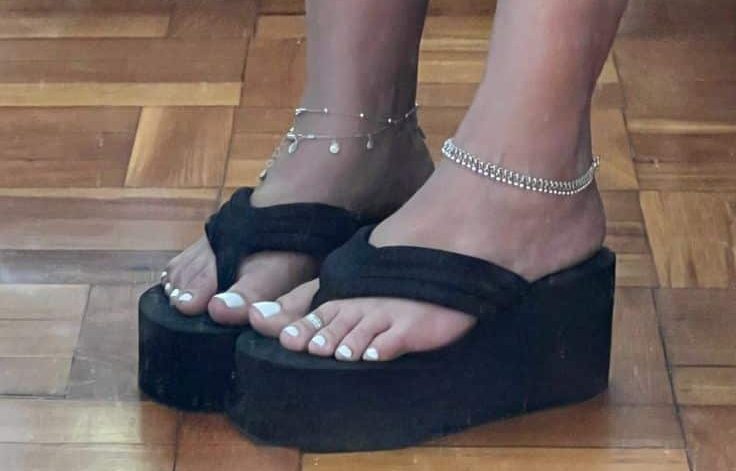
Some trends flare quickly and fade fast. A prime example from summer 2025 is the platform flip-flop revival. Once celebrated as a nostalgic “ugly” sandal comeback, influenced by ’90s Jennifer Aniston style, this bulky footwear craze had already lost momentum by mid-2025. Retailers like Zara and Coperni launched them early in the season, but by July, influencers began declaring them passé in favor of sleeker, minimalist slides
Other trends show real staying power. Take boho-style tiered skirts: embraced by influencers like Sasha Obama and featured in collections from Chloé and Isabel Marant, this look has grown consistently throughout Spring/Summer 2025, proving that nostalgic, romantic styles can carry through multiple seasons.
This is where trend forecasters can provide useful data to fashion brands who must know season-to-season how an increasing or popular trend will fare in the coming months. A trend that’s predicted to decrease in popularity the next season won’t be included in the brand’s upcoming collection, for example, leaving more room for new trends to take their place.
Design and merchandising technologies have greatly reduced the speed-to-market, and social media makes it so trends rise and fall overnight.
Here, high-fashion and luxury brands tend to be at least one season ahead of their bridge and fast-fashion counterparts. This is because they’re often the ones introducing new trends, and they tend to steer away from mainstream appeal in order to maintain their “trendsetter” status. At its peak, a trend is usually no longer carried by luxury brands in lieu of fast-fashion brands pushing these styles.
4. Trends must decline
On a related note, the decline stage closely follows the peak stage because it lives behind the fine line of market oversaturation. A trend’s widespread popularity is often its downfall, because consumers tend to grow tired of seeing too much of a trend, or start to feel too “mainstream”.
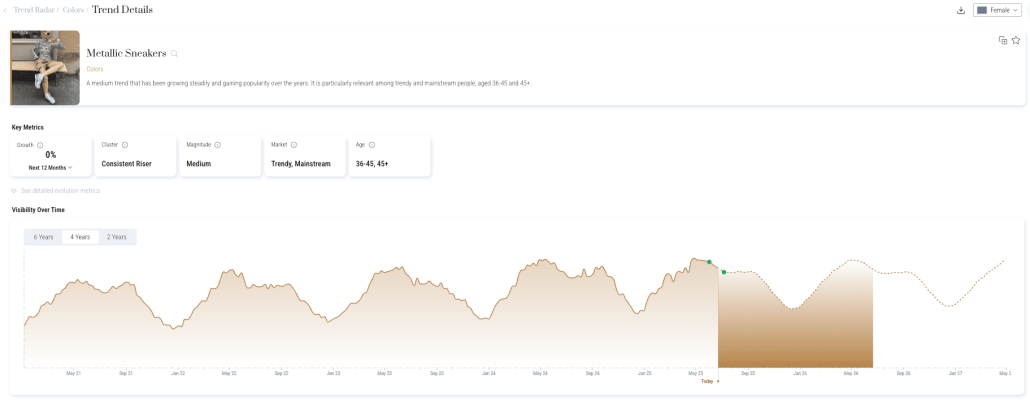
A notable example in 2025 is the holographic sneaker trend. Early in the year, TikTok was awash with metallic sneaker videos and street-style posts. These sneakers surged in popularity almost overnight but collapsed just as fast: by late spring, both influencer posts and consumer interest had dropped sharply. As with many fleeting crazes, brands and retailers rapidly discounted inventory before quietly phasing the trend out.
5. The obsolescence of a fashion trend
The final stage of a trend’s life cycle is called the obsolescence stage, during which a style becomes widely labeled as “out of fashion”. Consumers who shortly before enjoyed the trend move on to new peak trends and leave the obsolete trends behind.
Back in the 2000s, you couldn’t walk outside without seeing low rise jeans. High-fashion brands and celebrities saturated their collections with the style. A few seasons later, we saw a rapid decline in the trend, and it was replaced by high-rise before it ultimately disappeared from retailers’ clothing racks.
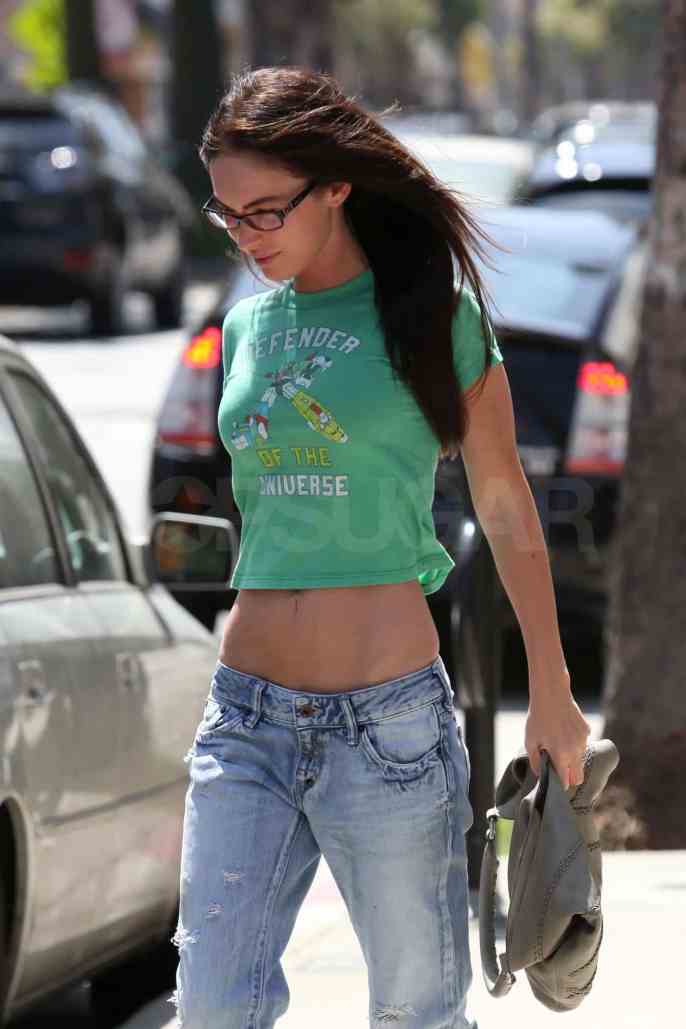

But an “obsolete” trend doesn’t necessarily imply that it won’t return to the fashion cycle; often, past trends are revamped to fit the current moment and once again experience a full life cycle. Despite its decade long absence from the market, the low rise is back.
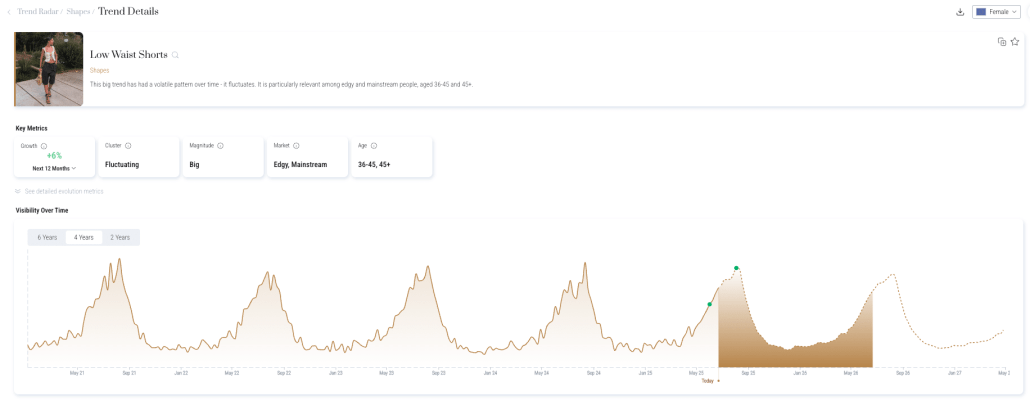
Inspired by the Y2K aesthetic, low-waist denim cuts have taken TikTok by storm, but what does the data say? According to Heuritech’s data, at the beginning of 2025, low-waist jeans saw a +5% increase in Europe among women, primarily adopted by more edgy, trend-driven consumers. During the same period in the U.S., the silhouette experienced an +8% increase compared to the previous year. When looking specifically at shorts, particularly low-waisted styles, the shape is projected to grow by +11% during the summer in the EU and by +3% in the U.S. For men, the low waisted shorts are estimated to increase +7% in the EU and +2% in the US.
The circle of fashion trends
While the life cycle of a trend can’t be predicted with 100% precision, it is possible to ascribe certain patterns to it in order to better navigate market changes. Again, the general life cycle of a trend is as such: introduction, rise, peak, decline, obsolescence.
With this model, fashion brands are better able to make collection decisions that will satisfy their customers. Luxury and fast-fashion brands may be on staggered trend calendars from one another, but the usefulness of understanding a trend’s life cycle remains the same.
Furthermore, trend forecasting contributes an extra level of precision to collection-making. Each trend moves through its life cycle in a unique way, so real-time data on specific trends is essential to pinpointing their past, present, and future behaviors.
How do social media and influencers impact the growth stage of fashion trends?
Social media and influencers have reshaped the fashion trend cycle, accelerating trend adoption at an unprecedented pace. Platforms like Instagram, TikTok, and YouTube serve as catalysts for virality, allowing trends to reach global audiences within hours. Influencers, from niche creators to mainstream celebrities, amplify this impact by showcasing emerging styles in real-time. This democratization of trend diffusion has shortened the traditional life cycle, making trends more dynamic yet more volatile.
How do luxury and fast-fashion brands differ in their approach to the trend life cycle?
Luxury brands set trends through exclusive runway collections, emphasizing craftsmanship and long-term appeal. They introduce trends early but move on quickly to maintain exclusivity. In contrast, fast-fashion brands rapidly replicate trends, making them widely accessible at lower price points. Their fast production cycles allow them to capitalize on peak demand, but also lead to quicker trend saturation and decline. While luxury focuses on longevity and brand heritage, fast fashion thrives on speed and constant novelty.
What are some examples of trends that quickly rose and fell in recent years?
Some trends have gained rapid traction, only to fade just as quickly due to social media’s fast-paced influence:
Cottagecore: A pastoral-inspired aesthetic that surged during the pandemic but gradually lost momentum.
Y2K Fashion: The early 2000s revival dominated social feeds but has started to decline as new aesthetics emerge.
Tie-Dye: A DIY-driven trend that peaked in 2020 but has since receded from mainstream collections.
Micro Bags: A statement accessory that briefly captured attention but proved impractical for everyday use.
These examples highlight the volatility of modern fashion, where digital culture fuels both rapid adoption and accelerated decline.