

Luxury fashion trends in 2026 are defined by one big shift: brands can no longer rely on price increases to grow, so they are investing in culture, heritage and product desirability instead.
The context is demanding. Bain forecasts only 2 to 4% growth for personal luxury goods in 2026, far from the double-digit years. In this environment, knowing where brands put their energy, and which products consumers actually adopt, has become a competitive advantage.
This article is based on Luxurynsight’s analysis of 4,931 brand activations in H1 2026, combined with Heuritech’s trend data on what consumers wear. Here are the 7 key luxury fashion trends that professionals in the sector need to know.
Luxury in H1 2026 at a glance
Brand activity accelerated in H1 2026: luxury houses launched 4,931 activations, up 14% compared with H1 2025. Activations cover every brand initiative, from product launches to campaigns, events and store openings.
| Sector | Activations H1 2026 | Growth vs H1 2025 | Share of communication |
| Perfume & Cosmetics | 2,118 | +7% | 58% |
| Watches & Jewelry | 1,459 | +39% | 55% |
| Fashion & Leather Goods | 1,354 | +4% | 51% |
Three signals stand out:
- Watches & Jewelry is the fastest-growing sector, with activations up 39%.
- Communication is taking over. It gained ground in every sector, while the share of retail initiatives declined. Brands are favoring storytelling over pure distribution.
- The geographic center of gravity is moving west. Europe (+56%) became the largest market with 29% of activations, and North America grew 70%. China-based activations fell 20%, although China remains a key market.
Source: Luxurynsight, H1 2026.
1. Price is no longer the growth engine
The era of double-digit price hikes is over. According to Luxurynsight’s price monitoring of leading leather goods houses, global bag prices rose by a median of 3 to 4% between January and June 2026, in line with the previous semester.
The real change is geographic. Brands now reprice selectively, market by market. Louis Vuitton raised 97% of its tracked bags in the US and 99% in Japan, but only 4% of its French catalogue and none of its Chinese one. Dior followed a similar logic, keeping French leather goods prices almost frozen while adjusting most of its bags in the US, Japan and China.
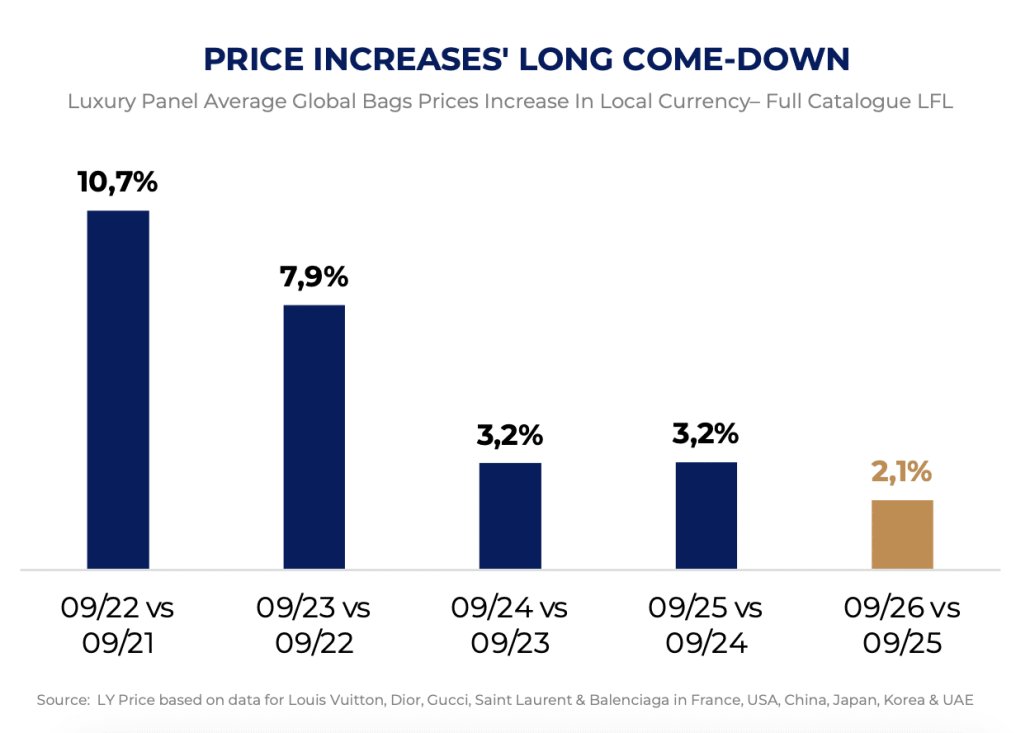
Currencies also play a growing role. In H1 2026, the dollar and the yuan strengthened against the euro, so local increases translated into higher euro returns. South Korea was the exception: a weaker won almost wiped out the local price increase once converted.
The takeaway for professionals: pricing power is fading. With Bain expecting modest growth and Hermès already signaling smaller increases for 2027, product and desirability, not price, now drive performance.
2. Sport becomes luxury’s biggest stage
In H1 2026, luxury stopped simply sponsoring sport and started living inside it. An exceptional calendar of mega-events pushed brands from short-term campaigns to lasting presence.
The Milano Cortina Winter Olympics set the tone in February. Ralph Lauren outfitted Team USA for the 10th consecutive Games, proof that these partnerships deliver long-term returns. Moncler partnered with Team Brazil around skier Lucas Pinheiro Braathen. Omega, Prada and Loro Piana went further, opening permanent stores in Cortina rather than temporary pop-ups.
The June FIFA World Cup pushed the logic further. Since official tournament sponsorship is tightly locked, brands signed directly with federations and players instead. Dior built an activation around Kylian Mbappé, and Loewe partnered with Spain’s national team through 2030.
Other events like Roland-Garros, with Lacoste’s full brand platform, and the Monaco Grand Prix, with Louis Vuitton as title sponsor, are now used as hubs to engage top clients.
The takeaway: sport is no longer a one-off visibility play. The winning brands commit for the long term, and adapt their playbook to each event’s audience.
3. Local festivals turn into global strategy
Local festivals are no longer tactical marketing moments. In 2026, they became a recurring pillar of luxury brands’ global calendars, planned with the same rigor as a runway show.
Ahead of Chinese New Year, houses moved beyond lunar-themed capsules toward full takeovers of heritage landmarks. Valentino staged an immersive experience inside the Tianhou Temple in Shanghai, while Miu Miu transformed Donghu Road. Loewe, Céline, Prada and Fendi also anchored installations in landmark locations across China.
The same approach reached the Middle East, where the Ramadan economy is projected to exceed US$66 billion in 2026 across MENA. Louis Vuitton, Dior, Valentino, Dolce & Gabbana and Jimmy Choo each paired capsule collections with regional celebrity ambassadors.
Loewe offers one of the clearest examples. For its first-ever campaign around Songkran, Thailand’s April water festival, the house cast local celebrities and created a Thailand-exclusive leather charm inspired by the country’s national flower. Rather than adapting an existing product, it built one for the market.
The takeaway: generic holiday capsules no longer resonate. Cultural immersion and market-specific products are becoming the norm.
4. Archive revival as a hedge against risk
In H1 2026, the archive became luxury’s default innovation pipeline. Amid creative director changes and economic uncertainty, houses favored silhouettes the market had already validated over the risk of launching a new icon.
The examples are numerous. Louis Vuitton built a collection around the Monogram’s 130th anniversary and brought back its Murakami Monogram Multicolor collaboration, discontinued in 2015. Gucci released a lightweight Bamboo 1947, Saint Laurent revived the Mombasa, and Balenciaga brought back the Le City.

Archives also found a new stage. During Milan Design Week in April, Fendi, Chloé, Armani and Tod’s chose design week over fashion week to unveil their revivals, from Fendi’s Baguette re-edition to Tod’s reinterpreted Gommino. Heritage is presented as culture, not as a seasonal drop.
Resale reinforces the trend. After Jonathan Anderson left Loewe, searches for his designs on The RealReal jumped 488%. By reissuing their own classics, houses capture that nostalgia value instead of leaving it to the secondary market.
The takeaway: newness now comes from execution, not invention. Proven icons offer brands a safer path to growth.
5. Jewellery, luxury’s strongest growth engine
Bain names jewellery the leading luxury category in 2026, while personal luxury goods overall grow only 2 to 4%. The major groups’ results confirm it:
| Group | Division | Performance |
| Richemont | Jewellery Maisons | +24% at constant rates, quarter to 30 June (EUR 4.73bn) |
| Kering | New jewellery division | +22% in Q1 |
| LVMH | Watches & Jewelry | +9% organic in H1 (EUR 5.2bn) |
For Richemont, this is a seventh consecutive quarter of double-digit growth, compared with +8% for its specialist watchmakers.
Groups are reorganizing around this bright spot. Kering launched Kering Jewelry, a dedicated platform bringing together Boucheron, Pomellato, DoDo and Qeelin. Richemont sold watchmaker Baume & Mercier to Damiani Group to focus on its best-performing hard luxury houses.
Brand activity follows the same curve: Watches & Jewelry activations grew 39% in H1 2026, the strongest increase of all luxury sectors.
The takeaway: jewellery has become luxury’s safe haven. Expect continued investment, consolidation and creative energy in the category.
6. The bag shapes to watch
Two bag shapes lead consumer adoption in 2026, and each has its own home market.
Vanity Bags dominate in Europe. They recorded the largest visibility growth among European women, up 48% in Q1 and 38% in Q2 2026, and 37% over the past 12 months. Their structured, compact shape fits the return of polished, ladylike dressing.
Y2K Bags lead in China. Their visibility grew 40% over H1 2026 among Chinese women. Looking ahead, Y2K Bags are expected to show the strongest growth in both Europe and China for the rest of 2026, with a forecast of +12% in China over the next 12 months.
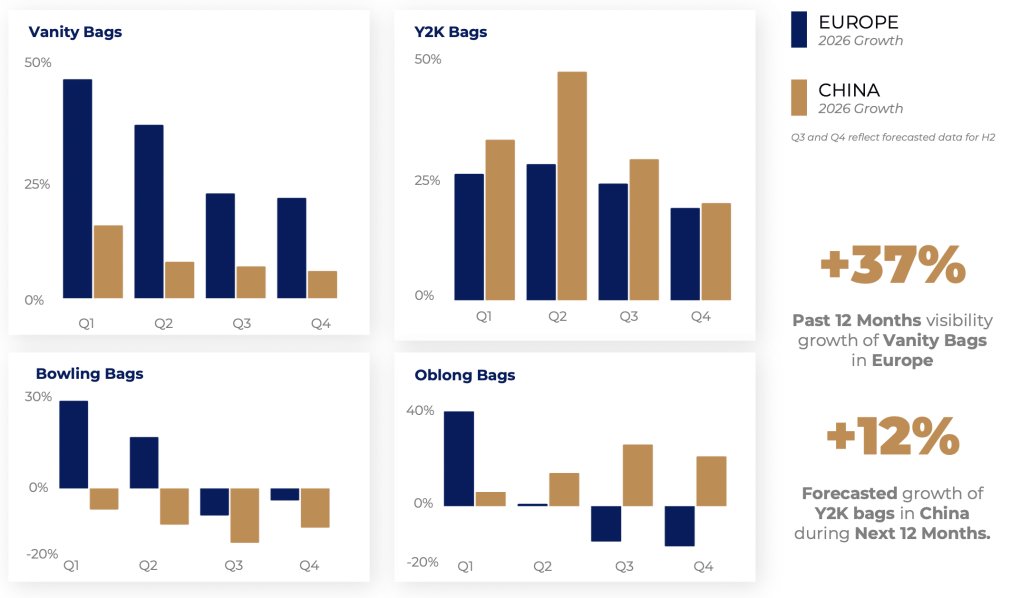
Other shapes show more mixed signals. Bowling Bags grew strongly in Europe early in the year, but are expected to slow down in H2. Oblong Bags follow the opposite pattern, with momentum building in China.
The takeaway: one global bag assortment no longer works. Shapes should be prioritized market by market, based on what consumers actually adopt.
Source: LY Trends, female segments, vs previous year. Q3 and Q4 are forecasts.
7. The three aesthetics that defined H1 2026
On the product side, three aesthetics shaped what consumers wore in H1 2026. All three share a common thread: a taste for contrast and personal expression.
Funboss: maximalism enters the office
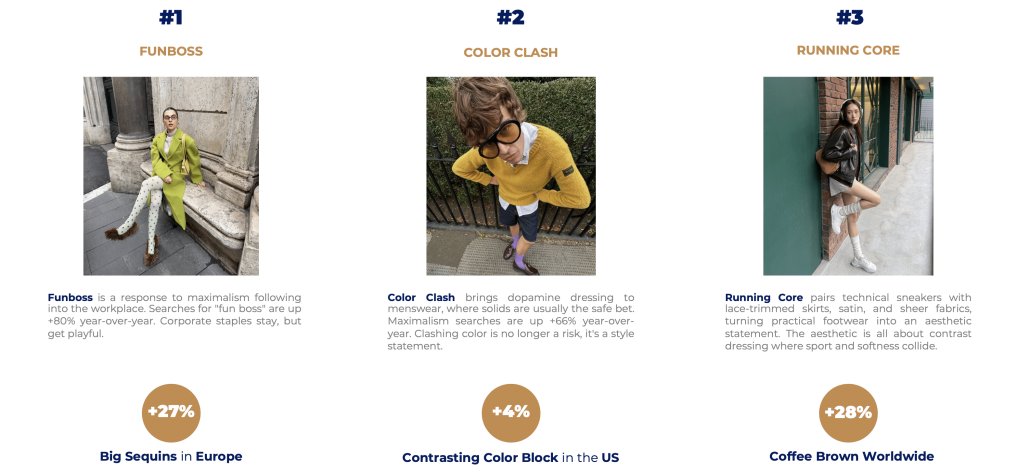
Funboss is power dressing with a sense of humor. According to Glimpse, searches for “fun boss” climbed 80% over the past year. The codes of professional dress remain, from the midi skirt to the tailored coat, but they are rewritten with brighter colors, unexpected materials, fur trims, feathers or sequins.
Accessories act as the exclamation point: a statement bag, a bold shoe, unexpected tights. The data confirms it, with dotted prints up 77% among European women and midi skirts up 4% among American women.
Color Clash: dopamine dressing reaches menswear
Color Clash brings bold color combinations to menswear, where solids have long been the safe choice. Searches for “maximalism” are up 66% year over year, according to Glimpse.
The trend relies on unexpected yet harmonious combinations. Prints help bring these contrasts to life: irregular horizontal stripes grew 14% among men in China and 19% in Europe. Bright shades like Greenfinch are reclaimed with a playful edge, beyond traditional gender codes.
Running Core: when performance meets softness
Technical sneakers are no longer confined to sport. Across runways, street style and social media, performance running and trail sneakers are paired with lace-trimmed skirts, satin dresses and sheer fabrics.
Performance running sneakers grew 28% among European women, and trail sneakers 25% in Europe. Styling is key: lace is up 16% among Chinese women, satin up 19% in China, and big dots up 80% worldwide. Consumers want performance and style bundled into a single purchase.
What these trends mean for luxury professionals
These luxury fashion trends point to a few clear priorities for brands, buyers and merchandisers:
- Invest in product and heritage, not price. With pricing power fading, desirability comes from strong products and validated icons. Archive pieces are a lower-risk way to deliver newness.
- Think market by market. Pricing, bag shapes and activations all perform differently in Europe, the US and China. A single global strategy leaves value on the table.
- Commit to cultural moments for the long term. Sport and local festivals reward brands that build lasting presence and market-specific products, not one-off campaigns.
- Watch hard luxury closely. Jewellery is the category where groups are concentrating investment and growth.
- Use consumer data to guide assortment. Aesthetics like Funboss, Color Clash and Running Core show which colors, prints and shapes consumers adopt, helping brands reduce overstock and improve sell-through.
Conclusion
Luxury in 2026 is reinventing how it grows. Price increases are no longer enough, so brands are turning to culture, heritage, sport and jewellery to keep consumers engaged. On the product side, contrast and self-expression lead, from Funboss to Running Core.
For professionals, the advantage lies in reading these signals early and precisely: which trend, in which market, for which consumer. To get these and more insights, we invite you to download Luxurynsight’s latest Global Luxury Brand Analysis report.
Want to anticipate the next luxury fashion trends in your categories? Book a demo with Heuritech to explore our trend forecasting data.ho plan with both data and editorial instinct.