


From Grand Slam tennis courts to the Grand Prix pit lanes and the World Cup stadiums, the world’s biggest sporting occasions have become one of the most coveted activation stages.
The runway was never enough
For decades, the fashion industry had one answer to the question of cultural visibility: the runway. It was a system that worked as long as the world consumed fashion on fashion’s terms. Of course, Fashion Weeks are still relevant to set trends. At Heuritech, we analyze the runways to predict which trends will protagonize the following seasons, which will be adopted by consumers. For sure, runway trends can generate big consumer adoption. But not all trends being worn were generated on the catwalk. A world where the only source of inspiration are runways no longer exists.
Today, consumers take inspiration from multiple sources. Social media. Icons they idolize. Influencers. Street style. The events that everyone is watching. Sports have been in the spotlight since the beginning, but in the last decades their level of exposition to consumers has become bigger. The spectator can watch from their phone screen: availability is ubiquitous. The seemingly unreachable athletes have been made approachable by documentaries, books, TV shows, videogames. Even the most private athletes have not been spared: Netflix just released a documentary on Rafael Nadal, a player famously guarded about his personal life. They have infiltrated popular culture. Two particularly popular entertainment successes come to mind: the FIFA videogame and Netflix’s Drive to Survive.
While consumers watch a Grand Slam final, a Formula 1 qualifying lap, or a World Cup group stage match, it’s inevitable to absorb what players have on, what drivers show in the paddock, what fans wear in the stands: all of it is now content, all of it can now be taken as a trend signal. But sports events go further than what fans see on screen. They touch emotional fibers. If your idol has something on that you can buy yourself, that will make you feel closer to him, generate a connection, that’s definitely something brands will exploit.
Sport events are one of the most effective platforms for brand activations that reach a global, emotionally engaged, and commercially consequential audience. The athleisure segment alone is projected to reach $647 billion by 2030, growing at a compound annual rate of around 10%. North America still leads global revenues, but Asia-Pacific is the fastest-growing region, and the signals coming from emerging markets in the Gulf, Southeast Asia, and Latin America suggest the ceiling is nowhere close.
What makes sports events specifically relevant, beyond sportswear, is influence. Sports events compress cultural attention. They concentrate hundreds of millions of viewers, global press, and an endlessly algorithmically amplified social media loop. Live sport reaches across demographics, geographies, and income brackets. There’s not many places where you can have all coincide. Brands trying to land a message at scale, in context, with emotional resonance, know no media buy replicates that. It is hard to find an equivalent of what a well-chosen sports partnership delivers.
Tennis: Grand Slams now serving looks and guiding design briefs
Grand Slams have become a surface for brand positioning and trend setting. The pleated tennis skirt should not exist as a mainstream fashion object in 2026. By the normal fashion cycle, it peaked with the Miu Miu moment, went massive, and should be in clearance by now. It has maintained above-baseline adoption for six consecutive seasons. The reason it hasn’t died might be related to the hype created around tennis tournaments, thus renovating the silhouette’s credibility, where its worn by players whose every outfit choice is photographed and posted before the match is over.
Roland-Garros continues to push beyond the boundaries of a traditional tennis tournament. In 2026, the event had already broken an attendance record before the main draw began: Opening Week alone brought in 138,000 spectators, the highest figure in the tournament’s history. That early momentum builds on a strong 2025 edition, when nearly 690,000 spectators attended the Grand Slam at Porte d’Auteuil.
The French Open has become one of sport’s most commercially distinctive platforms for brands. Its appeal is structural: two weeks of elite sport, Parisian cultural capital and a global high-value audience. As in previous editions, several heritage brands including FRED, J.M. Weston and Lancel activated through co-branded capsule collections. The tournament also increasingly grows as a key moment for brand visibility beyond official tournament partnerships. Gucci’s campaign around Jannik Sinner, Material Good’s custom necklace for Aryna Sabalenka show that Roland-Garros now drives visibility through player-led storytelling and styling moments as much as through official sponsorship.
Lacoste, a partner of the tournament since 1971 with its agreement now extended to 2030, has built a complete activation system for this year’s edition. Following the launch of its new global campaign, “The Run,” the French brand debuted an official capsule collection, unveiled a custom walk-on jacket for Djokovic, introduced a Club Lacoste rooftop court takeover in Paris, staged a bar residency at Le Royal Monceau, and set up a Galeries Lafayette pop-up in Mumbai. Rather than limiting its Roland-Garros presence to product visibility, Lacoste used the tournament as a brand platform, turning its tennis heritage into a coherent mix of product, hospitality, athlete storytelling and consumer-facing experiences. As the tournament’s commercial gravity continues to grow, the question for brands is no longer whether to be present at Roland-Garros, but how much of it they are willing to build around.
The USTA reported nearly 24 million Americans currently playing tennis, marking four consecutive years of growth. In a single year, tennis sponsorships jumped 41% and brand advertising in the sport soared 40%, growing faster than Major League Baseball, Major League Soccer, and the NBA.
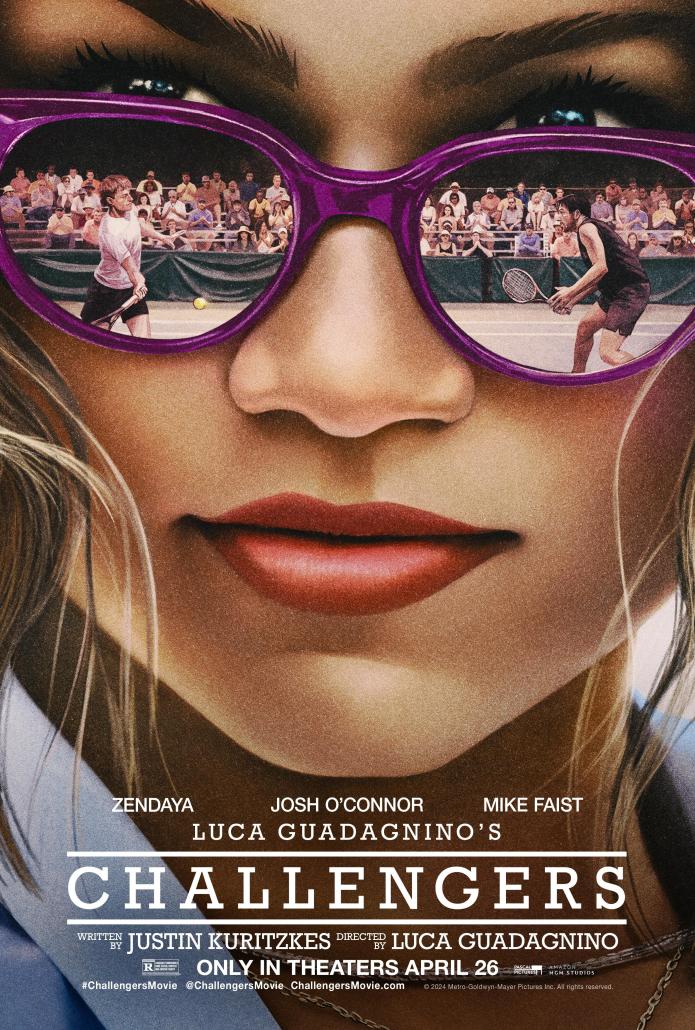
Luca Guadagnino’s Challengers and the press tour that followed, with Zendaya dressed by the iconic Law Roach, a pair known for their outstanding ‘method dressing’ outfits, where they adapt the looks to the movie’s aesthetic; accelerated tennis’ imposition as a trend. Released in April 2024, it made tennis feel erotic and emotionally high-stakes in a way that required no prior knowledge to appreciate. It made tennis a palatable sport for anyone and everyone. Once more, an example of physical activities infiltrating popular culture. Searches for adult tennis lessons skyrocketed 245% worldwide after its release. On Depop, searches for tennis skirts and polo shirts rose 52% and 53% respectively. Netflix’s Break Point had already done some groundwork; peeling back the sport’s traditionally pristine image to reveal the vulnerability and ambition beneath, a deliberate replication of what Drive to Survive had done for F1. The tenniscore aesthetic, at the intersection of quiet luxury and old-money style codes, landed together with these releases.
In Wimbledon 2023, Jannik Sinner walked onto Centre Court carrying a custom Gucci monogram duffel bag, bumping further the tennis core craze. It was the first time a luxury bag made its appearance on center court. Alcaraz has been a Louis Vuitton ambassador since 2023. Nike, which sponsors both Sinner and Alcaraz, faced pointed criticism after the 2025 Roland Garros final: a five-hour-twenty-nine-minute match in front of millions of viewers, and outfits that had, according to one analysis, “so little aesthetic consistency” with the rest of the NikeCourt collection. The court is now a design brief.
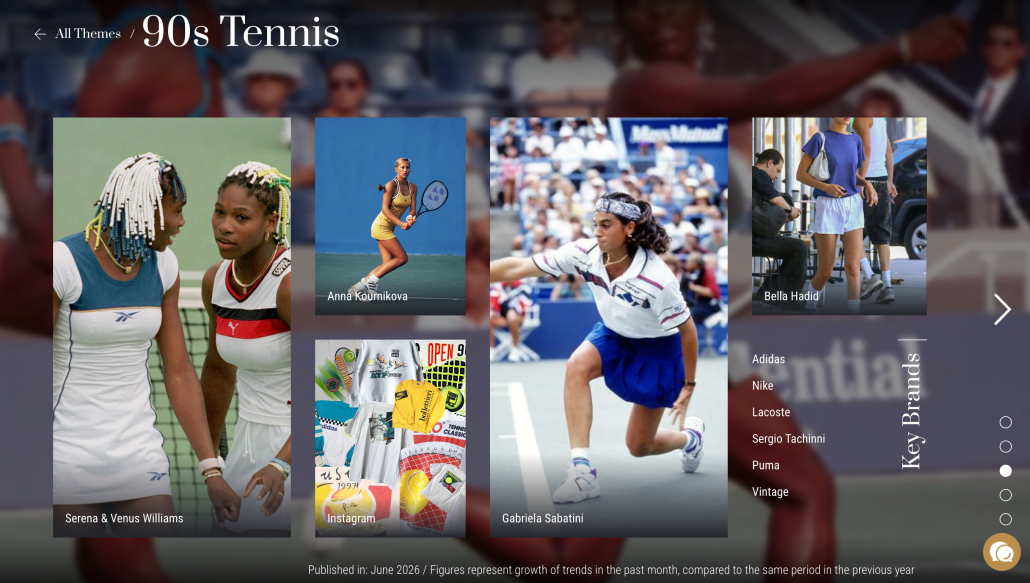
According to Heuritech’s data, tennis short skirts have seen a 22% decline in the past 12 months in the EU market, and are expected to decline a further 15% in the next 12 months. Windbreakers are up 5% year-on-year and retro trainers will grow 6% in the next 12 months. They are one of the key garments defining a theme released by Heuritech: 90s Tennis. Beyond windbreakers, buttermilk yellow and jersey mini dresses are the aesthetic’s definers. According to our fashion team: “consumers are embracing the decade’s bold color-blocking, graphic prints, visible branding, and personality-led styling. 90s tennis is being reinterpreted through a lens of self-expression, representation, and unapologetic individuality.” Plimsolls are forecasted to grow +8% among European women in Q4 2026, reinforcing tennis footwear’s growing role within the broader retro sportswear movement. Grand Slams are providing a recurring cultural infrastructure that keeps tennis fashion commercially alive.
Formula 1: The paddock as the world’s aspirational runway
The transformation of Formula 1 into a fashion platform happened faster than anyone could have predicted. The Netflix series Drive to Survive was supposed to explain a sport. Beyond that, it created a cast of characters: young, attractive, wealthy; and gave them a global audience that had never watched a race in its life but was very interested. Invested, if you will.
The paddock is a contained space of extreme visibility: a few hundred metres of access road where drivers, team principals, celebrities, brand executives, and accredited media are compressed into the same space. Every Grand Prix weekend generates thousands of photographs. Collectively, they have started to constitute a street style report. Instead of Copenhagen or Milan, the location is Monaco or Miami or Suzuka, and instead of editors on their way to a show, the subjects and their partners are some of the most followed people on the planet. Alexandra Malena Leclerc’s latest instagram posts, for example, have gained millions of likes, her looks and lifestyle creating fascination across the board.
Monaco’s race weekend confirmed Formula 1’s standing as luxury’s fastest-growing showroom. Supported by an increasing popularity and by rising viewership figures of about 827 Mn (+12% YoY), the championship has become prime territory for brands to reach younger audiences as well as high-net worth individuals, as illustrated by LVMH’s strategic partnerships wiring Louis Vuitton, TAG Heuer and Moët & Chandon into the sport’s commercial architecture.
No venue on the calendar makes that logic more legible. Ranked 6th in the Savills HNW Individuals Hotspot Index, the Principality draws more than 80% of its residents from abroad, averaging a net worth of $20 Mn per head (according to 2025 IMSEE data) and concentrating roughly 1 UHNWI for every 39 residents. This year, Louis Vuitton held the title sponsorship, pairing a special capsule and bespoke trophy trunk with its debut Monaco City Guide and VIP yacht experiences, while Gucci used Monte Carlo as the backdrop for a summer travel campaign. In watches, TAG Heuer revived its most storied name through the fifty-piece Monaco Speed 12, while Richard Mille relocated to a flagship ten times larger than its previous Monaco store. The weekend also drew more lifestyle-led activations: Alo continued its Riviera push after Cannes with a Grand Prix wellness voyage, while APM Monaco partnered with Nikki Beach for a rooftop takeover. In the days around the event, the category field also broadened, with Gucci confirming its 2027 Alpine title partnership and SkinCeuticals becoming Ferrari’s first skincare partner.
Formula 1 offers brands a rare combination: broadcast reach into a global audience skewing younger and increasingly female, alongside direct on-site access to high-net-worth consumers and Monaco GP takes that combination to its highest intensity. Singapore in September will offer the next test of the same logic: a street circuit in Asia’s premier wealth hub, where the on-site UHNWI concentration mirrors Monaco’s but with the added lens of a region whose high-net-worth base is still in structural expansion.
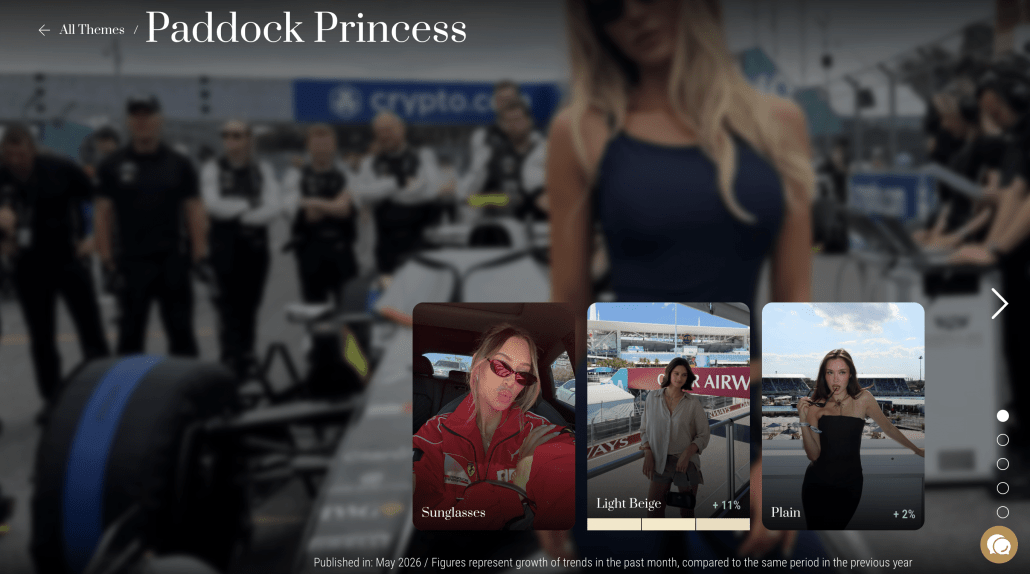
The fashion industry responded the way it always responds to a new cultural surface: by colonising it. Racer fashion was put into the spotlight. On Heuritech’s platform, the Paddock Princess theme reflects how a fashion-driven identity shaped by the glamour, speed, and increasingly refined aesthetic surrounding contemporary racing culture has become popular. Ferrari’s alignment with Prada for team uniforms is now five years old. Mercedes with Tommy Hilfiger, Aston Martin with Hackett, Red Bull with its own vertically integrated fashion line (Alpha Tauri).
The US fanbase has reached 52 million, growing 11% YOY, with live race viewership up 21% versus the prior season. The US is now the largest F1 market for YouTube viewership and social media followers; the latter up 445% since 2018. China and the Middle East each grew over 10% in 2025. These are the same markets where new races have been added, and where luxury brand activations have concentrated.
Football: Wondering how to reach everyone?
Tennis and Formula 1 are platforms that have been historically perceived as economically elevated. They are expensive sports. Their audiences skew affluent. They are excellent environments for brand equity building at the luxury end of the market. Football is different, because it is watched by, essentially, everyone on the planet. The last FIFA World Cup final engaged 5 billion fans across all media platforms. The final had 1.41 billion viewers.
The World Cup is the largest recurring cultural event on earth. The 2026 edition, spread across the United States, Canada, and Mexico is the tournament’s largest edition ever, with 48 teams and 104 matches. The cumulative attendance record set in 1994 is now on course to be surpassed, with projections pointing toward as many as 6.5 million fans in the stands across 16 host cities.
For 2026, FIFA is projecting close to 6 billion engagements, a figure that would place the tournament among the most-watched events in history and, crucially, in front of audiences across virtually every major consumer market at once. The competition crosses every income level, every language, every relationship. The grandmother in Dakar who has never heard of a fashion week, the teenager in Jakarta who will not buy a luxury product for another fifteen years, the middle-income family in Guadalajara watching the quarterfinal together… all of them are watching the games. Many people that don’t watch football on a daily basis tune in for the world cup. It’s a uniting sports world event.
This reach helps explain the level of activity among fashion and luxury houses, for which the World Cup has become a rare opportunity to address a global audience simultaneously. On the official-partner front, Loewe dresses Spain, Jacquemus and Nike handle France’s pre-match wardrobe, Gabriela Hearst tailors Uruguay in national merino wool, Mackage outfits Croatia and Zalando signs Belgium through 2030. Each pairing leans on a similar logic, associating a house’s craftsmanship and codes with a national team’s identity and the prestige of the competition. The ambassador approach is just as widely used, with David Beckham for Boss, João Neves for Ami Paris, as brands tap into athletes’ disciplined images and large social followings to reach younger consumers.
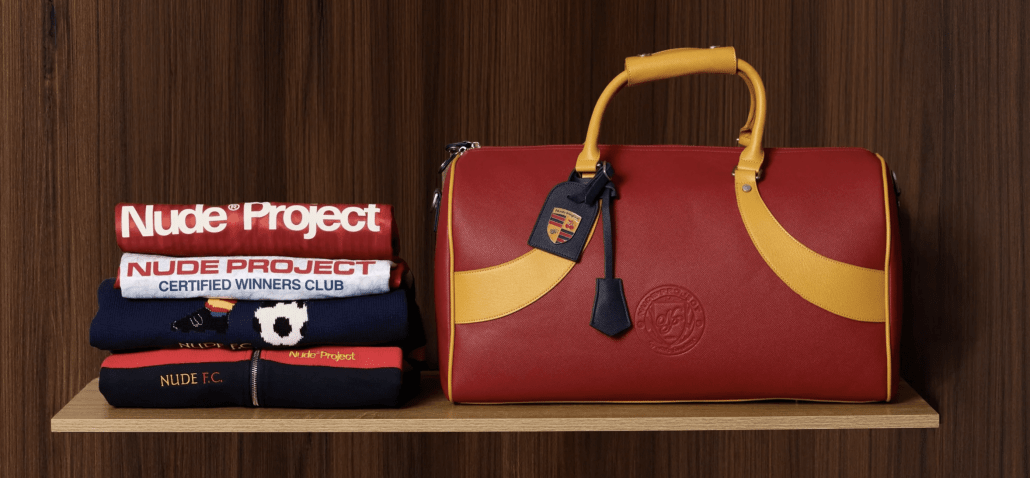
The football kit is increasingly becoming a serious design object. Many clothing brands have taken advantage of FIFA’s biggest event and have released their own reinterpretations of the country’s kit. Nude Project, the Spanish streetwear brand that has built its entire identity around cultural proximity to its audience, has released their version of the Spanish uniform. And they built one of the season’s smartest activations to go with the drop: a raffle that scales every time Spain wins. All you need is an €1 ticket to enter a draw whose prizes get more valuable with every Spanish victory. Football tees for the group stage, a full zip for the round of 32, a track jacket for the round of 16, a soccer barrel bag at the quarter-final, a trip for two to the final if Spain reaches the semi; and a leather jacket if they lift the trophy. They successfully attached the emotion of Spain’s victories to Nude’s brand identity. It’s genius.
Beyond the kits, the tournament extends into retail and lifestyle: Adidas enlists Timothée Chalamet for its Backyard Legends campaign in a role that channels his inner Marty Supreme energy, viewed by 8 million people on Youtube, and rolls out installations across 35 Nordstrom locations; Puma unveils its Ultra Nitro 7 boot in Los Angeles, Boggi Milano and Levi’s release commemorative capsules, Bloomingdale’s turns its Carousel into a “Game Day with Boss” shop, and Paula’s Choice takes on the role of official skin care partner. From tailoring to pop-ups and athlete-fronted campaigns, the competition has become a stage where heritage houses, sportswear giants, department stores and beauty brands all look to position themselves, each on its own terms. Football objects have thus gained enough cultural weight to sustain creative conversation. We have yet to see how much this World Cup will influence trends, but we are already seeing a strong effect on brand catalogs.
NBA: Knicks historic road to victory and the Tunnel BDP (Best Dressed Player)
This June, the Knicks won their first championship since 1973. Fifty-three years. The longest drought between titles in NBA history. They closed it out in five games against the San Antonio Spurs, the same franchise that had beaten them in the 1999 Finals. Several media outlets called it one of the best Finals series of the last decade. It was the most-watched NBA Finals since 1998 at 20 million viewers.
The NBA’s tunnel walk, the 90 seconds between the team bus and the locker room, players arriving in whatever they chose to wear, has become one of the most photographed moments in sport. ESPN covers it, Vogue covers it too. Again, this means that you can reach fashionistas and basketball fans at the same time.
Tyler Kolek, the Knicks’ backup point guard, was crowned Finals Tunnel MVP, maybe it would be more appropriate to award him BDP, for his off-court appearances across the series, including a standout look combining a vintage Issey Miyake jacket, Prada jeans, and Chanel boots. Madison Square Garden, the playing arena, is in midtown Manhattan, fifteen minutes from every major fashion house showroom in America, surrounded by media infrastructure. When New York wins, the fashion industry is in the room. Timothée Chalamet, Kylie Jenner, Taylor Swift were courtside. The celebrity attendance at NBA Finals is yet another source to build brand authority.
The broader NBA fashion story, of which the Knicks are the current apex, was born from an act of suppression. In 2005, commissioner David Stern introduced a dress code requiring players to wear business attire to games: a policy widely read as a direct rebuke of the hip-hop aesthetic that had become inseparable from basketball.
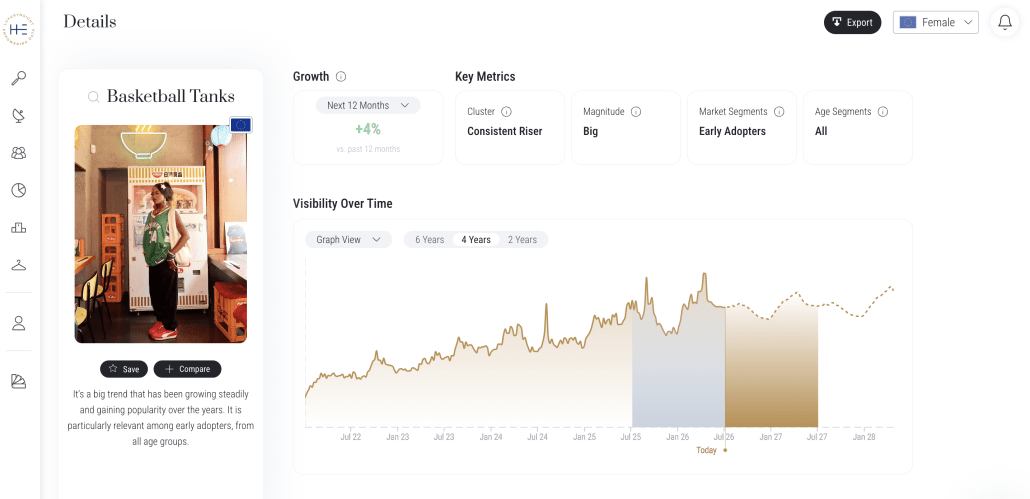
What the league did not anticipate is that pre-game fits would become a thing. It soon became a competition over who could dress the best. How you dress became a cultural touchpoint. The dress code did not suppress NBA fashion but created it. As Cavaliers star Darius Garland put it: “Hip-hop culture influences basketball, and basketball influences hip-hop culture. Everyone wants to see what athletes are wearing so they can wear it. We are the influencers”. According to Heuritech data, Basketball tanks are expected to grow 4% in the European market in the next 12 months across all market segments. What emerged was the tunnel walk as a runway, and the NBA player as an influential fashion voice. The arena became another platform where brands competed for attention.
The Super Bowl: Fashion’s biggest thirteen minutes
The Super Bowl halftime show is one of the most-watched fashion moments in the world. It’s broadcasted to over 120 million people simultaneously, and dissected by every fashion publication on earth before the second half kicks off.
The halftime show has functioned as a luxury showcase for years. Rihanna’s 2023 performance (all-red custom Loewe catsuit, Alaïa puffer, MM6 x Salomon sneakers) was a masterclass in luxury brand placement at scale. Lady Gaga arrived in Versace. Beyoncé in Balmain and DSquared2. A performer booked for the Super Bowl became, by default, booked to deliver a luxury brand moment to one of the largest television audiences of the year.
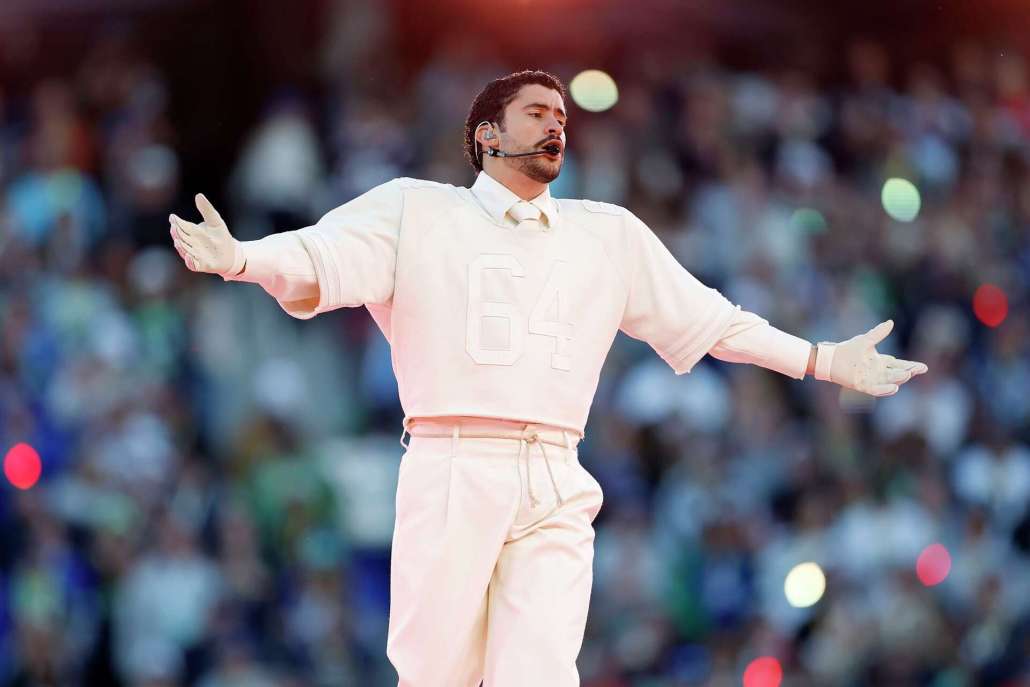
In 2026, Bad Bunny broke the code. At Super Bowl LX, he walked out in a cream-coloured Zara suit and his Adidas BadBo 1.0 signature sneaker. Zara also dressed his backup dancers, band, and orchestra. The fashion industry’s reaction was split. Business of Fashion correspondent Mike Sykes put it plainly: “Bad Bunny’s Super Bowl show was made to be accessible for everyone. It was a show about love, community and inclusivity. Wearing pieces made by brands that cost tens of thousands of dollars wouldn’t have matched that moment.” CNN Style’s Oscar Holland framed it as a quiet political statement: “One quietly uttered message may have been about accessibility; and a reluctance to flaunt wealth at a time when many American households face rising costs.”
The numbers told their own story. Launchmetrics calculated that Bad Bunny’s thirteen-minute set generated $170 million in Media Impact Value in just twelve hours. Zara alone earned an estimated $3.1 million MIV from the appearance. A standard Super Bowl advertising slot costs around $7 million for thirty seconds.
Bad Bunny’s look was a cream long-sleeve button-down and tie, under a reimagined football jersey with his surname, Ocasio, on the back and the number 64 on the front, paired with string-tied trousers. On his wrist: an Audemars Piguet Royal Oak valued at approximately $75,700. Maybe not so democratic after all? Or maybe a demonstration that you can do luxury and mass market brand publicity at the same time. The show’s power does not belong to luxury by default. It belongs to whoever understands the cultural moment well enough to dress for it. The logic applies for the rest of sportswear events.
Sports, attention and the fight for retaining it
Everything written above is about brands using major cultural events to leverage attention. Specifically, about weaponizing the particular kind of attention sport generates: emotional, shared, democratic.
A good brand positioning strategy is about integration: being so embedded in the visual and cultural language of the event that the distinction between the sport and the brand stops being visible.
The argument for data intelligence in this context is not complicated, but it is often misunderstood. Brands do not need data to tell them that Roland Garros matters, or that F1 has a fashion moment, or that the World Cup reaches five billion people. Luxurynsight’s and Heuritech’s goal is to provide eyes for the things brands cannot see. Heuritech tracks adoption curves two years in advance with 91% accuracy. The difference between a detail appearing on a court and that detail reaching above-baseline adoption in consumer wardrobes involves a six to eighteen-month arc that varies by market, by demographic, and by the competitive landscape at the moment of adoption. Getting that timing right is the difference between being the brand that defined a trend and being the brand that arrived at the clearance sale.
Luxurynsight adds what product data alone cannot provide: the market intelligence on which brands are capturing the commercial benefit of each sports moment, in which territories, and whether the opportunity is still open or has already been claimed. In a landscape where every major brand is paying attention to the same events, the advantage is not in knowing that the moment exists. It is in knowing what to do with it, and when.


