


For decades, fashion brands have designed collections months in advance, produced them on historical assumptions, and crossed their fingers the market would catch up. Sometimes it pays off with a bestseller; more often, it ends in deadstock and aggressive markdowns.
Today, however, the landscape has fundamentally shifted. Demand forecasting for fashion products aims to reduce this inherent uncertainty by turning volatile, trend‑driven demand into predictable, quantifiable patterns. The goal is to better align production, inventory, and markdown policies with real consumer demand.
If you are a fashion professional looking to move away from intuition and build a more resilient, data-backed supply chain, this guide outlines how to modernize your demand forecasting strategy.
Why Fashion Demand is Inherently Uncertain
Before solving the problem, we must understand why forecasting in this specific industry is so notoriously difficult. Fashion sits at the complex intersection of several volatile variables:
- Short Life Cycles and Fickle Trends: Unlike consumer electronics or household staples, a fashion garment might only stay relevant for a few months — sometimes weeks. What sells out in March can be dead stock by June.
- Extreme SKU Proliferation: A single style is rarely just one item. It spans multiple colors, fabrics, and a full size run, and forecasting a ‘v-neck sweater’ is very different from forecasting the ‘v-neck sweater in magenta, size medium’.
- The Flaw of Historical Data for New Products: Traditional forecasting relies heavily on past sales, but what do you do with a completely new silhouette or a print that has no precedent in your archives?
- External Noise: Seasonality, erratic weather patterns, promotional calendars, pricing shifts, and sudden competitor moves create massive amounts of “noise” in the data signal. Did a jacket sell well because it was a great design, or simply because it was unseasonably cold and a competitor was out of stock?
Core Strategies to reduce forecasting uncertainty
To navigate this volatility, leading brands are restructuring their demand‑planning processes. Here are the practical levers you can pull to reduce unpredictability and protect your margins.
Combine Historical Data with External Signals
Relying solely on last year’s sales figures to dictate next year’s production is a recipe for overstock. While time‑series methods (such as exponential smoothing or ARIMA models) are useful for establishing a baseline on core, carry-over items, they fail spectacularly when applied to new or fast‑changing products.
To build a robust forecast, you must augment historical data with external, forward-looking signals. This involves analyzing search data, early‑season sell‑through rates, and crucially, social media engagement. By observing what consumers are actively wearing and interacting with online, you can explicitly reduce reliance on intuition. Discover more about how to capture these signals through social media based trend forecasting.
This technology allows you to elevate your “risk” tier from a pure gamble to a calculated strategy. You can confidently create trend-forward collections knowing there is a forecasted, quantified customer demand. It empowers your teams to push boundaries, knowing that their most innovative, risky garments are perfectly aligned with upcoming market realities. You take the guesswork out of fashion, protecting your investment while maintaining your creative edge.
Adopt Probabilistic Forecasting
The traditional forecasting model usually provides a single “point” forecast (e.g., “We will sell exactly 5,000 units”). In a volatile market, this number is almost guaranteed to be wrong.
Instead, modern merchandising teams are shifting toward probabilistic forecasting. This means modeling a range of likely outcomes—a low, base, and high demand scenario—each assigned a specific probability. The result is smarter safety stock sizing, more accurate initial orders by size and color, and markdown triggers that are planned rationally rather than reactively.
Leverage AI and Machine Learning for Fast-Changing Styles
One of the biggest changes in demand planning over the last decade has been the integration of artificial intelligence. Hybrid models combining statistical baselines with dynamic inputs like seasonality, promotional activity, and social media signals consistently outperform traditional methods. Leading retailers report double-digit reductions in both stockouts and leftover inventory. The reason is simple: AI spots complex, non-linear patterns across massive datasets that no spreadsheet can capture. To understand the technology driving this shift, explore the mechanics of trend forecasting fashion AI.
The Heuritech Edge: Translating Visuals into Predictable Demand
Understanding that you need AI and external signals is the first step; operationalizing it is the second. This is precisely where Heuritech’s technology redefines the forecasting landscape.
We understand that the most authentic signal of consumer desire isn’t found in a post-season sales report—it is found in what consumers are actively wearing in real life and sharing online. By analyzing millions of social media images monthly, Heuritech’s visual recognition technology detects over 2,000 specific fashion attributes, ranging from shapes to granular prints, fabrics, and colors.
We take this unstructured visual data and pass it through our proprietary predictive algorithms. This allows brands to forecast market demand through consumer data with unprecedented accuracy. Instead of guessing if a new trend will catch on, Heuritech provides a quantified growth trajectory for that specific attribute across different consumer segments and geographies.
By integrating Heuritech’s insights into your workflow, rigorous fashion forecasting is no longer limited to high-level seasonal themes; it becomes a granular, actionable metric that dictates exactly how deep you should buy into a specific SKU.
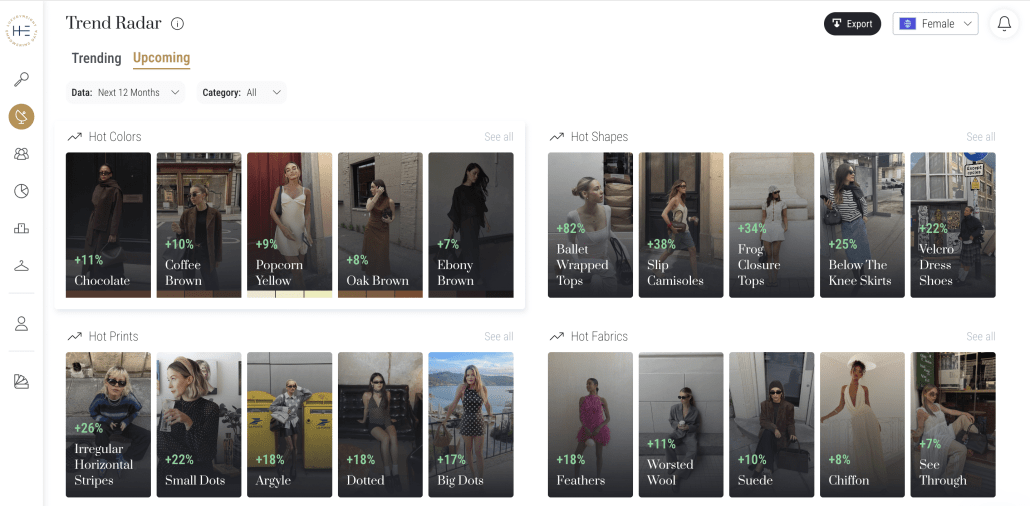
Image: Data from Heuritech Trend Forecasting Platform
Operational Levers to Support the Forecast
Even with the most advanced AI and predictive data, the future will always hold a slight margin of unpredictability. Therefore, you must build operational processes that can tolerate and adapt to uncertainty.
Implement “Test‑and‑React” Production
Move away from the rigid model of producing 100% of a collection upfront. Implement demand-driven production by starting smaller. Launch capsule drops or commit to limited first buys for high-risk fashion items. Once the product drops, monitor real‑time signals such as early sales, regional performance, and online engagement. If the item gains traction, you scale production rapidly. If it fails to resonate, you have successfully mitigated the risk of mass over-production.
Dynamic Safety Stock and Service‑Level Policies
A one‑size‑fits‑all rule for safety stock is inefficient. Instead, adjust your safety stock dynamically down to the SKU level. Calculate this based on the specific forecast volatility of the item, its production lead time, and its profit margin. A high-margin, highly volatile fashion piece requires a different buffer strategy than a low-margin, stable core basic.
Collaborative Planning with Retailers
For wholesale brands, blind spots at the retail level are a massive source of volatility. Real‑time sharing of data between brands and retailers is crucial. By maintaining open visibility on retailer forecasts, backorders, and current stock positions on the shop floor, brands can adjust their upstream production and replenishment cycles before demand surprises cause damaging stockouts or pile up into deadstock.
From Guesswork to Informed Decisions
Demand forecasting for fashion products will never be an exact science, but it no longer has to be a blind gamble. By moving beyond historical sales, embracing probabilistic models, and integrating cutting-edge AI to decode consumer behavior, brands can drastically reduce uncertainty.
The tools to turn volatile trends into predictable, profitable strategies are already here. Whether you operate in mass-market retail, fast fashion, or luxury seasonal collections, matching your specific data sources to the right forecasting workflow is the definitive key to protecting your margins and ensuring your brand’s longevity.
Eager to learn more about our approach and how we can help you better anticipate demand? Contact us for a demo.


