


Prints remain a central force in fashion, shaping each collection with new aesthetic directions and cultural influences. Today’s trends span retro inspirations, bold graphic experiments and nature-inspired patterns, with a strong impact on luxury, streetwear and ready-to-wear. From Paris to Milan, designers explore vibrant florals, surreal motifs, refined heritage checks and elevated color palettes to keep pace with a market hungry for innovation. At Heuritech, our data-driven insights track social media signals and runway shifts, pinpointing the print concepts set to dominate the seasons ahead. Our Trend Calendar provides a clear roadmap of the trend evolution, helping brands anticipate demand and align their collections accordingly. In this report, we’ll explore the must-know fashion print trends shaping the market and offer practical guidance for business professionals and creative teams alike.
Why do print trends matter?
A print is more than a decorative design. It expresses a brand’s identity, shapes consumer perception and drives sales across fall, winter or resort collections. Three major forces propel fashion print trends today:
- The return of maximalism, balanced by heritage: After several seasons of minimal style and neutral palettes, prints came back to energize dresses, outerwear and accessories. Clashing patterns and statement designs still lead, but the most recent runways have paired that boldness with a renewed appetite for heritage codes, tartan, houndstooth and gingham reclaiming a sense of textile literacy and craft.
- Social media as a trend catalyst: Photogenic motifs spread quickly on Instagram, TikTok and beyond, pushing certain patterns, like oversized polka dots or animal stripes, into mainstream popularity.
- Sustainability and textile innovation: Eco-friendly fabric production, water-free digital printing and biodegradable pigments signal a new era for textiles. These emerging methods let designers create eye-catching prints with minimal waste.
At Première Vision, one of the industry’s leading trade shows, designers and manufacturers showcased innovative print directions aligned with Heuritech’s data-driven insights. From bold, surrealist motifs to nature-inspired graphics, the trends spotted at the event reinforce the growing demand for expressive, sustainable and digitally native prints, in line with Heuritech’s forecasts.
Brands must adopt a strategic approach when choosing motifs, prioritizing those that resonate deeply with their audience and anticipating each trend’s lifecycle.

Eternal summer: Sun-drenched stripes and optimistic prints
A bright, serotonin-charged aesthetic is reshaping everyday dressing for FW27/28. The Eternal summer story, tracked by Heuritech across social media and runway data, leans into playful simplicity and sun-drenched optimism: rooted in ease but expressed with confidence. It represents a decisive shift away from quiet luxury and broadly palatable aesthetics, ushering in a more expressive approach to everyday dressing that celebrates dynamism and a vibrant visual identity.
The defining print expression of this story is the stripe. Striped Basic Lifestyle Tees are forecast to grow +26% in womenswear for FW27/28 versus FW25/26 in the EU, driven primarily by the Mainstream segment: a sign that this is beyond a fleeting runway moment; it’s a broad consumer shift. Eternal Summer lifts spirits and amplifies energy, carrying the essence of summer through the transition into fall. Preserving the euphoric feeling of warm August nights, bubbly soda, and melted sorbet, this aesthetic never quite lets summer slip into winter’s stillness.
Digital florals: Hyperrealism and bold colors
Floral prints keep taking on a futuristic twist. Technological advancements in textile printing, particularly digital and water-free methods, allow for crisp edges, vivid hues and near-photographic detail. Designers like Dries Van Noten and Richard Quinn have pioneered this shift, blending hyperreal florals with contemporary silhouettes.A counterpoint has emerged on the most recent runways: alongside hyperreal saturation, designers at Dior, Shushu/Tong and Altuzarra have explored softer “bedtime florals,” delicate florets in pastel shades with frilly, Regency-inspired detailing. This romantic direction is closely aligned with the “Wither & Will” story in Heuritech’s FW27/28 Trend Edit, symbolizing historical references are becoming more important for a consumer that searches meaningful fashion. Lace materials are forecasted to grow +4% in womenswear for FW27/28 versus FW25/26 in the EU, with Thick Lace growing a further +3% over the same period, as delicate and textured fabrics gain ground alongside heavier elements. Together these directions prove the floral remains endlessly versatile, suiting everything from spring dresses to winter layering across multiple seasons. For designers seeking to create next-level prints, romanticism and florals represent an unmissable opportunity to stand out in a competitive market.

Sport & varsity stripes: The new athleisure print
Inspired by team uniforms and athletic kits, varsity stripes bring a graphic edge to everyday fashion. References to rugby shirts, baseball jerseys and college letterman jackets appear across runway week and street style. Polo Ralph Lauren and Wales Bonner have popularized this trend, pairing bright primary colors with high-contrast lines for visual impact. The look easily transitions from casual to luxe, with design studios introducing stripes on tailored trousers, structured blazers and even formal dresses. This sporty twist performs well across the fall and resort seasons, catering to consumers who crave a balance between comfort and statement design.
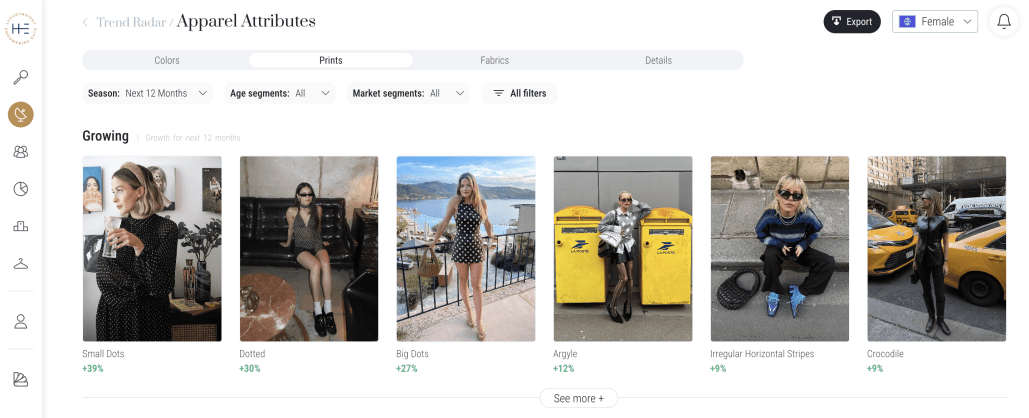
Heuritech’s forward-looking data confirms strong momentum into late 2026 and FW27/28. Irregular Horizontal Stripes are forecast to grow +10% in Q3 2026 among men in the EU, linked to tennis culture and the US Open, as the most fashion-forward Grand Slam allows players to wear more expressive prints and patterns; while the same pattern is forecast at +9% in womenswear for FW27/28 versus FW25/26 in the EU. Once tied to classic polos and knits, the pattern is being revived with looser, uneven garments that feel more relaxed and contemporary, becoming a core cross-gender pattern shaped by the ongoing crossover between sport and everyday style.
Animal prints: A data-backed resurgence
Animal prints remain a powerful force, having dominated social media and moved from spectacle to a more polished, controlled expression of power on recent runways. Leopard continues to lead as a genuine staple, but the category has broadened: tiger appeared at Kim Shui, zebra at Fendi, python and snake at houses like Valentino and Chloé.
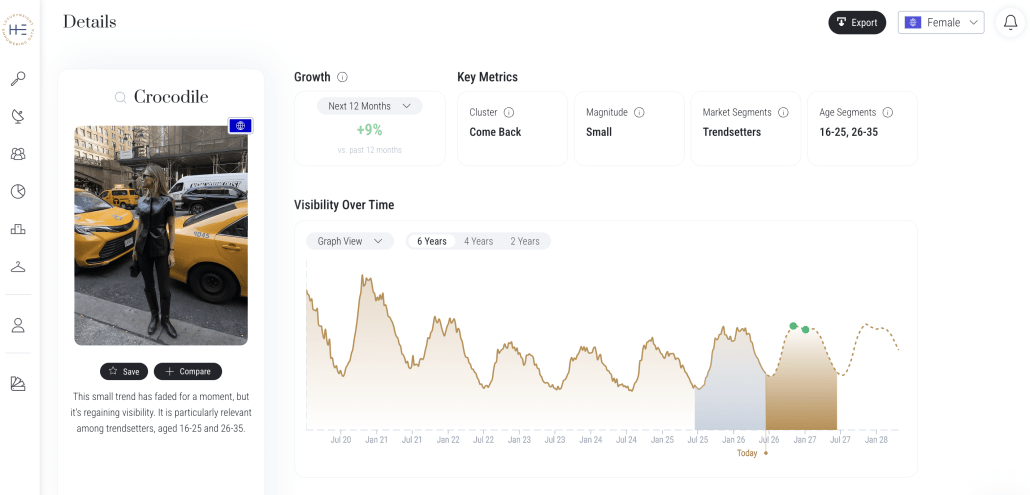
Crocodile print is expected to grow 9% for women worldwide, followed closely by tiger, which is expected to grow by 6% in the next 12 months in the same area. Zebra and snake are expected to decline 4%; while cow print is expected to go down 29% in visibility. In specific categories, leopard will decline 10% in dresses and 6% in skirts for women worldwide. Overall, animal prints will be declining 2% worldwide and 9% in Europe, but they are expected to grow 4% in the US market. Animal print outerwear remains the highest growing category.
In terms of silhouettes, jackets and midi skirts have been key drivers of the trend, proving animal prints’ versatility in statement pieces and everyday fashion. Heuritech’s runway tracking confirms the category maintains a Come Back trajectory with Big magnitude, as it evolves across styles and platforms in fresh and dynamic ways.
Big Dots: The highest-growth print of late 2026
Polka Dots have been the undisputable winners of the season. At Heuritech, we track them in two sizes: big and small. Big Dots represent the clearest data signal in Heuritech’s current forecasts for late 2026. The print is forecast to surge +147% in Q4 2026 versus Q4 2025 in womenswear across the EU, with +24% growth forecast over the following 12 months. The trend taps into a broader appetite for bold, graphic expressions, moving away from discreet micro-motifs toward oversized, high-impact shapes.
Its rise is fuelled by the crossover between contemporary art culture, notably Art Basel Paris in November, where large-scale installations and circular forms dominate the public eye; and a renewed consumer appetite for playful, photogenic graphics. Classified as a Rising Star with Big magnitude, Big Dots is one of the highest-conviction print calls in Heuritech’s data for the season ahead.

Heritage checks and plaid: A comeback
Checks are expected to boost in visibility heading into late 2026 and FW27/28. Plaid is forecast to grow +16% for men in Q4 2026 versus Q4 2025 and +10% for women over the next 12 months (Come Back, Big magnitude, all consumer segments), confirming its relevance as a gender-inclusive winter staple. For the coming season, the plaid treatment extends across overshirts, structured collars, v-neck cardigans, midi skirts and classic button-downs. On the colour front, deep navy combinations are set to be key, balanced by softer beige and warm brown tones that keep the palette grounded and wearable.
How can brands leverage these print trends?
Selecting prints for different market segments
Luxury collections sometimes highlight high-definition motifs, such as intricate floral patterns or oversized graphic prints, often showcased on premium fabrics to enhance their exclusivity. In ready-to-wear, designers may opt for more versatile prints (e.g., understated stripes, heritage checks or refined laces) that integrate smoothly into existing wardrobes. Meanwhile, streetwear often blends diverse influences, like bold animal prints, sporty stripes or oversized polka-dot details, to produce distinctive looks that can capture social media attention and spark consumer enthusiasm.
Reconciling trend-driven prints with long-term appeal
Some creative teams introduce classic or scaled-down motifs (e.g., subtle checks or smaller florals) to ensure the collection retains relevance beyond a single season. Others employ updated printing techniques, such as digital processes or reduced-waste methods, addressing growing sustainability discussions within the industry. A number of brands divide their print usage: bold, eye-catching patterns appear on statement pieces (like outerwear or dresses), while simpler motifs feature on accessories, potentially extending a product’s lifecycle and minimizing excess stock.

The future of print trends
The trajectory of fashion print trends will continue evolving at the intersection of art and technology. Looking ahead, we expect:
- Interactive motifs: patterns that respond to color changes, temperature or sunlight.
- AI-driven creation: automated pattern-generation software for personalized prints.
- On-demand printing: as part of the upcycling movement, designers may use limited-edition runs to reduce excess fabric and leftover stock.
- A continuing wave of animal-inspired patterns across women’s wardrobes, with tiger and crocodile prints.
Heuritech’s predictive models help business leaders and creative teams stay ahead of these shifts. By monitoring real-time data, brands gain access to actionable insights, enabling them to deliver free-spirited, inspired concepts that resonate with modern consumers.
Global insights: What’s growing and what’s declining in fashion prints?
Global data from Heuritech reveals which print trends are likely to lead the European market over the coming months. Certain prints are growing in popularity, while others are on the decline, shaping the overall landscape ahead.
Growing trends:
- Big Dots (+147% Q4 2026 vs Q4 2025 / +24% next 12 months, womenswear EU). The highest-growth print in Heuritech’s current forecast, fuelled by art culture crossover and a decisive shift toward oversized, high-impact graphics.
- Striped Basic Lifestyle Tees (+26% FW27/28 womenswear EU). The Eternal Summer stripe moving into the mainstream, driven by broad consumer adoption beyond early adopters.
- Irregular Horizontal Stripes (+10% Q3 2026 men EU / +9% FW27/28 womenswear EU). A playful, asymmetric pattern gaining momentum across both genders, driven by sport-fashion crossover.
- Plaid (+16% men Q4 2026 / +10% women next 12 months, EU). A gender-inclusive heritage check reclaiming wardrobe space across a wide range of silhouettes.
- Lace (+4% FW27/28 womenswear EU) and Thick Lace (+3% FW27/28 womenswear EU). Delicate textile prints gaining ground as romantic, historically-referenced dressing builds momentum for the season ahead.
Decreasing trends:
- Lumberjack checks. Overtaken by more refined and contemporary heritage interpretations such as plaid and gingham.
- Psychedelic prints. Losing ground as consumers shift toward cleaner, more graphic expressions and data-backed optimism replaces maximalist nostalgia.
- Micro-motifs and small discreet prints. Being displaced by the clear consumer appetite for oversized, high-impact shapes, as evidenced by the Big Dots trajectory.
- Zebra, snake and cow prints. Losing ground as bolder and more versatile animal print expressions, particularly leopard and crocodile, continue to increase.
These insights, based on real-time social media and runway data, reflect a broader global shift in consumer preferences, reinforcing the importance of staying ahead of the trends and anticipating market movements.
A year of change in fashion prints
The coming months in fashion will see significant shifts in print trends, with bold, expressive patterns and renewed heritage codes leading the way. Designers must leverage these insights to create collections that resonate with modern consumers, balancing trend-driven motifs with timeless appeal. With the right data, brands can ensure they stay ahead of the curve, engaging audiences with prints that reflect both current influences and future possibilities.


