


With fashion under heightened scrutiny, Gen Z is changing not only what consumers are buying, but what they expect the industry to represent. This generation has accelerated trend cycles, changed the mechanics of brand discovery and put sustainability, transparency and authenticity high on the agenda. Its importance is more than purchasing power. Gen Z may not have the biggest wallets in the market today, but they are increasingly the force that sets the tone for tastes, behavior and expectation across it.
There is a real paradox in that influence. Gen Z wants more accountability from fashion, but is still part of a system built on constant novelty. It values individualism but is also attracted to fads that can go global in hours. It has welcomed resale even as fast fashion continues to offer an endless stream of cheap alternatives. Instead of inconsistency these tensions indicate something more fundamental: the consumption of fashion is no longer organized around one dominant priority. Identity, affordability, discovery and values are always changing in relation to each other.
Identity: Fashion as Self-Expression
For Gen Z, fashion is less a fixed style than a continual process of redefinition. Clothing is a visible extension of self. Shaped by digital culture and a desire to stand out, not blend in. As stated in a McKinsey article; “Fashion is a prominent tool for Gen Z to signal belonging and self-conception,” adding the cohort is particularly focused on individual expression.
Social media has magnified this dynamic. TikTok. Instagram. The creators who animate them. Fashion is no longer a seasonal discovery but an endless cultural stream. A niche subculture can be catapulted into the mainstream in a matter of days, and a dormant style can be reawakened just as quickly. Fashion, then, provides Gen Z with something more than the product itself: a mode of participation and signaling, in which the freedom to remake an esthetic is more valuable than the esthetic.

Behaviour: A Wardrobe Across Channels
That appetite for experimentation is reflected in buying behavior. Young consumers aren’t brand loyal or committed to one retail format, moving through fast fashion, resale, vintage, independent labels and established houses creating a wardrobe defined more by an assemblage of price points and influences than loyalty.
This behaviour also marks a clear contrast with older generations such as Gen X. While Gen Z’s shopping journey is increasingly shaped by social media, creators and digital discovery, Gen X takes a more considered, omnichannel approach. They may research products online, but still place strong value on the in-store experience, where they can evaluate quality, materials and fit before making a purchase. Their shopping habits tend to be more planned and research-driven, with quality, reliability and longevity often taking priority over fleeting trends. The contrast highlights how generational differences are not only reflected in what consumers buy, but also in how they discover, evaluate and ultimately choose products.
Gen Z is also showing a growing preference for timeless, versatile pieces that can be styled across different aesthetics. At the same time, viral microtrends and innovative colour palettes can refresh wardrobe essentials without requiring a complete overhaul.
Resale has proven particularly consequential. Platforms such as Vinted, Depop and Vestiaire Collective have made second-hand fashion considerably more accessible, while fast fashion continues to supply the velocity and affordability that rapid trend cycles demand. A single Gen Z wardrobe often features cheap fast-fashion staples mixed with secondhand finds, according to a McKinsey research.
The purchase journey has been accordingly re-designed. Increasingly, discovery is pre-determined by creators and algorithms before any direct experience of a brand’s website. 40% of Gen Z consumers in the US say they’ve been influenced by content they came across online. Price is still equally important: 73% of American Gen Z consumers said they had changed their spending habits because of rising prices in 2025, while 70% of UK Gen Z consumers said that affordability was their most important consideration. The resulting profile is one of pragmatism, balancing aspiration with constraint.
Contradiction: Where Values Meet Reality
Gen Z is vocal about sustainability and ethics, yet its purchasing behaviour does not consistently follow the same logic. McKinsey reports 73% of Gen Z consumers say they try to buy from ethical companies, while nine out of 10 believe business has a responsibility to fix environmental and social problems. But the speed of trend cycles often outstrips those intentions.
The way to think about this is not as a failure of conviction, but as a set of tradeoffs, usually financial tradeoffs. A sustainably made garment may speak to the values of a consumer but they may be able to afford a cheaper alternative . Gen Z cannot be reduced to either the conscious consumer or the fast fashion consumer, but it is both, depending on the moment, the product and the price. The same instability is what explains the generation’s valuing of authenticity, the expectation that sustainability claims will withstand scrutiny rather than be used as a marketing tool.
3 Gen Z Fashion Trends Decrypted with Heuritech’s AI-Powered Insights
Heuritech’s AI-powered trend forecasting technology helps fashion and sportswear brands predict consumer trends. The platform analyzes millions of social media images to identify emerging shifts in colors, fabrics, silhouettes, and prints across different consumer segments and markets. Heuritech’s data applied to Gen Z demonstrates how the wider behaviors of self-expression, experimentation and nostalgia are translating into specific fashion trends.
Yellow takes center stage
Ever since the summer of 2025, when yellow entered the eye of Gen Z, the color has continued to make an impact and is not estimated to stop. The color could be viewed as an introduction to Gen Z’s wish for more maximalism, expression, and personalisation in fashion.
Past month data, calculated from August 2026:
- Popcorn Yellow +22% Women Worldwide / +10% Men Worldwide
- Cardboard Khaki +20% Women EU / +10% Women Worldwide
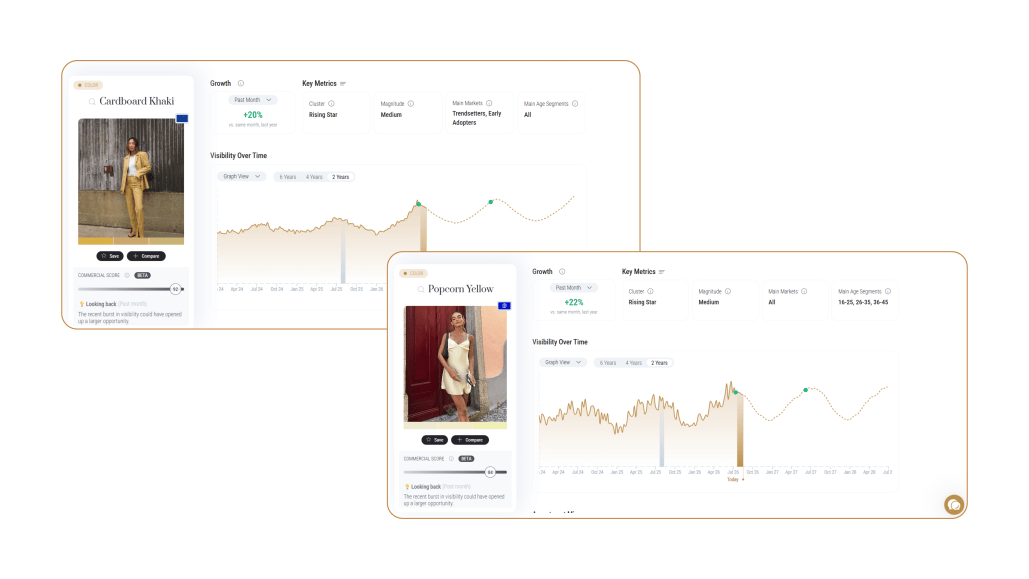
Since color trends often travel in families, the past month also shows a growth of +19% for Yellow Orange (Worldwide Women).
Ringer Tees: when the past becomes fashion’s future
The growing interest in vintage among Gen Z (think grandpa core, 90’s revival) has, in turn, led fast fashion brands to mimic retro trends. Consumers are increasingly drawn to pieces that feel familiar and authentic. The Ringer Tee captures that feeling while still looking relevant today. It has a timeless appeal that makes it easy to wear, but the contrast neckline and sleeve details give it enough character to feel current. In a market where consumers are becoming more intentional with their purchases, pieces with longevity and character tend to resonate.
Past month data for Ringer Tees, calculated from August 2026:
- +28% Women Worldwide / +27% EU / +36% US
- +54% Men Worldwide / +39% EU / +42% US

Roaring back, prints reclaim the spotlight
Gen Z also favours playing around with prints. Back in 2024, animal prints made a strong mark, and since then, the evolution of animal prints has shifted from leopard to Tiger Print (+43% WW Women) and Crocodile (+35% WW Women). Not only that, different versions of dots, regardless of whether it’s Small Dots (+73% WW Women) or Big Dots (+52% WW Women), have been everywhere, from Maxi Dresses to Halter Neck Tops, Mini Shorts, and even Windbreakers.

Impact on the Industry
Gen Z’s influence is far greater than its own spending. The traditional path from collection to consumer is no longer. Social platforms can turn a nascent esthetic into a commercial opportunity overnight. Same for communication which has evolved in parallel: the brand is no longer the only author of its story, campaigns compete with creator content for attention. Transparency is now non-negotiable, with claims about sourcing and sustainability expected to be backed by tangible evidence across product, supply chain and business model alike. At the same time, as the market for resale and repair becomes more and more organized around access rather than ownership, circularity is edging closer to the core of the industry.
Why the Industry Is Focused on Gen Z
What the industry is obsessing over with Gen Z has less to do with the group’s current spending power and more to do with its cultural clout. Gen Z is one of the least brand-loyal generations fashion has seen: just 29% of the average Gen Z wardrobe is from one brand, compared with 52% for those aged fifty and over. Attention can be acquired quickly, but also lost just as easily, so the relevance of relevance is based on its ongoing engagement with culture, not a static image.
Couple that with financial pressure and the equation becomes a tough one: consumers want better products and better practices but aren’t willing or able to pay a premium that matters. The challenge of sustainability is thus a challenge of value proposition to a large extent.
Ultimately, Gen Z is not transforming fashion because it has resolved the industry’s contradictions. It is transforming fashion because it continues to expose them, seeking individuality without excess, sustainability without unaffordability, and authenticity without losing the excitement fashion is meant to provide. For brands, understanding Gen Z requires moving beyond what the generation believes, toward what happens when those beliefs meet the realities of the market.


