


At Première Vision Paris (September 1st to 3rd), the Fall-Winter 2027-28 forum offered a clear message: after years dominated by digital acceleration, visual immediacy and increasingly standardized aesthetics, fashion is turning its attention back to the physicality of the product.
Under the season’s overarching theme, “Living Matter”, material is no longer treated simply as the support for a silhouette or color. It becomes the source of desirability itself. Texture, irregularity, transformation, protection and traces of time all play a central role, while technology increasingly works beneath the surface rather than demanding to be seen.
Première Vision structures this concept around three complementary scenarios: “Matter of Time”, “Matter of Ease” and “Wild Matter”, all organized in micro-thematics. Together, they reveal an FW27-28 season caught between past and future, craftsmanship and technology, human imperfection and biological innovation.

In terms of colors, it follows the same direction. FW27-28 moves away from straightforward primary shades toward more ambiguous pigments: Première Vision describes colors as if they too had been transformed by time, blurred, patinated and layered rather than perfectly saturated.
The range comprises 27 shades, and nuanced neutrals dominate alongside cooler shades carrying subtle digital undertones, creating a palette suspended between organic and technological worlds.
Deep Violet Code and Tannic Bordeaux provide alternatives to conventional black and navy, while Silicone Pink introduces a lighter, more artificial softness. Names such as Mycelium Beige, Waxy Glow and Algae Gel themselves reveal the season’s preoccupation with matter: colors are imagined through biological, tactile and transformative references.
Greens and pigmented greys are particularly relevant to “Wild Matter”, where the palette oscillates between earthiness and biotechnology. Rather than the straightforward natural greens associated with traditional eco-aesthetics, these shades feel modified, hybrid and almost laboratory-grown.
The result points toward a broader shift in luxury: newness no longer necessarily needs to look new. Visible time, complexity and imperfection can instead communicate authenticity, longevity and emotional value.
“Matter of Time”: imperfection becomes precious
Perhaps the most immediately fashion-relevant direction is “Matter of Time”, where age, wear and imperfection become signs of value.
Patinated surfaces, washed finishes, creases, rubbed effects and irregular textures give materials the impression that they have already lived. Rather than aspiring to pristine perfection, fabrics and leathers increasingly reveal their history. Première Vision connects this aesthetic to a wider renewed appreciation for craftsmanship, heritage and time-intensive savoir-faire: in a world of instantaneous and increasingly AI-generated imagery, evidence of the human hand becomes a form of distinction.
This is not simply vintage nostalgia. Historical references are being reworked rather than reproduced. Classical influences, traditional techniques and artisanal constructions coexist with contemporary treatments, creating products that feel familiar yet altered.

Bottom, left to right: Terra Optima, Soieries Chambutaires

The “Jewellery Box” micro-thematic embraces maximalist textures, from metallic-thread tweeds, jerseys and cloqués to sequin-embroidered laces, all of them in powdery shades, bringing a subtle sense of historical flamboyance.
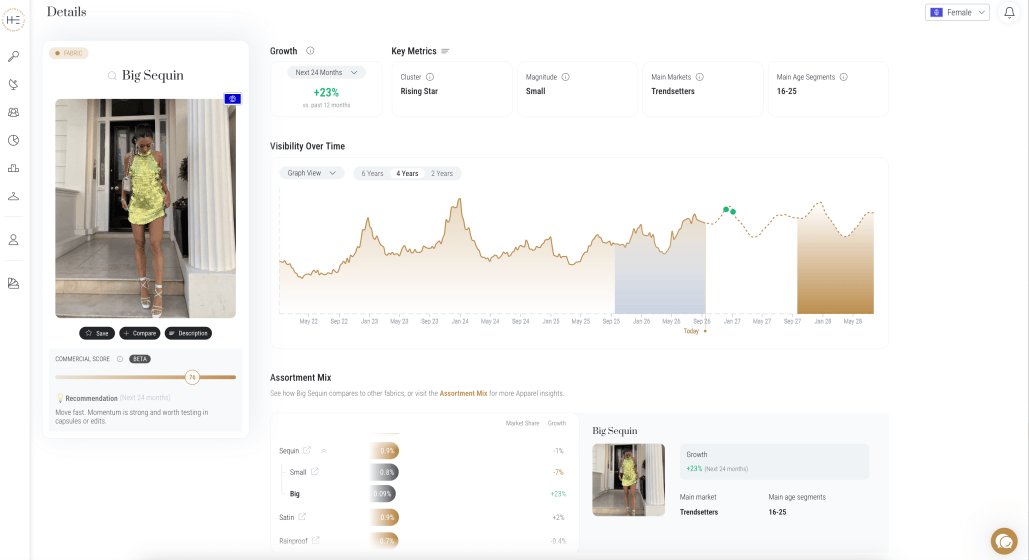
Based on our data, Big Sequin is a Rising Star trend for Worldwide-female consumers, especially among Gen-Z Trend Setters, and is expected to grow in adoption by +23% in the next 24 months.

Bottom, left to right: Sophie Hallette, Hangzhou Embsense Embroidery, Dong Xin Fei Lin Technology Industrial

“Matter of Ease”: technology disappears into the garment
If “Matter of Time” reconnects fashion with the past, “Matter of Ease” looks toward a more human version of the future.
Here, technical innovation becomes increasingly invisible. Rather than overtly futuristic surfaces or aggressively technical aesthetics, Première Vision highlights materials that quietly improve the experience of wearing a garment. Comfort, protection, mobility and adaptability move to the foreground.
“Silky Drapery” focuses on refined urban wools, from rich cashmere to fine virgin wool, where the soft touch is creating a chic and comfy look, while “Performance Tailoring” brings breathability, layering, windproofing, and water-repellent properties to office wear.

Bottom, left to right: Danmao Textile
Innovation happens in classic garments, such as in the fabrics presented also in the Casual forum.
“Technical Silks” combines Polyamide with a silky softness and a crisp, crinkled finish, bringing an urban edge to featherweight technical fabrics designed to transition seamlessly from work to after-work.

For sports and outdoor, sporty jerseys and milano knits (viscose, polyester, elastane, recycled polyamide) present subtle, muted sheens and a peach-skin feel, in shades ranging from violet to brown.
According to our data for Worldwide/women, Performance Jersey is a Massive, Consistent Riser trend among all markets, forecasted to grow in visibility by +7% in the next 24 months.

Innovation also comes through next-generation materials, from Oliatex’s olive-based leather alternative to Brewed Protein™, a protein fiber produced through microbial fermentation, bridging nature, biotechnology, and material innovation.
Garments become interfaces between body and environment through enveloping materials, active softness and discreet performance. Technology remains essential, but the visual expression becomes quieter and more intuitive.
This direction feels particularly relevant as the distinction between fashion, activewear and outdoor clothing continues to erode. Performance is no longer necessarily something a garment needs to advertise visually. A classic-looking fabric can carry sophisticated functionality; softness can coexist with protection; technical properties can sit inside increasingly familiar wardrobe staples.
The broader implication is significant: innovation is moving from spectacle to service. The smartest product may increasingly be the one whose technology the consumer barely notices.
“Wild Matter”: nature becomes a system, not a print
The most experimental part of the forum comes through “Wild Matter”, where nature is approached less as decorative inspiration than as a model for creation itself.
Organic growth, mineral surfaces, fermentation, mycelium, biological transformation and regenerative processes inform materials that appear unstable, irregular and alive. Instead of reproducing flowers or leaves literally, fashion looks toward the mechanisms of the natural world like growth, adaptation, mutation and decomposition.
This produces a very different idea of natural beauty. Surfaces can appear raw, proliferating, powdery or imperfect; lines become fragmented and irregular; negative space and unfinished effects allow the material to feel as though it is still evolving.
This is exemplified with “Living Fermentations”, that evokes the irregular color stains of mold and other growing biological matter, creating organic, abstract prints and effects.

Bottom: Mona Knit
In the same, “beauty of the wild idea”, “Muted Patinas” highlights weathered surfaces and sophisticated, dusty hues. Echoing this aged aesthetic, “Earthbound Imprint” features timeworn leathers that convey a refined, lived-in elegance.

Bottom, left to right: Gruppo Mastrotto, Inkor Fashions
Similarly, “Unruly Piles” reimagines classic fur through wild, shaggy textures and untamed long piles.

Bottom, left to right: EPS, Malhia Kent
At the same time, the concept reaches beyond aesthetics. Première Vision points to developments including mycelium and industrial fermentation as examples of how biological processes can inform new material systems. The show itself reinforced this direction through its innovation offer: the September edition included next-generation materials derived from food waste, mycelium-based biomaterials, PLA fibers, closed-loop recycled polyester and plant-based fur alternatives.
Here, nature and technology are not opposites. Biology itself becomes technology.
Conclusion: from perfect product to products with presence
Taken together, the Première Vision forum suggests an important evolution in how fashion may define desirability for FW27-28.
The season is not rejecting technology, it’s quite the opposite. AI, biomaterials, advanced performance and new production technologies remain deeply embedded in the industry’s future. Nearly 900 international exhibitors gathered at the September show, with innovation, traceability, circularity and advanced materials forming a significant part of the offer.
But aesthetically, the response to technological acceleration appears increasingly human.
Materials carry marks. Colors become difficult to define. Craftsmanship becomes visible. Surfaces wrinkle, fade and evolve. Technical performance disappears beneath softness. Nature is allowed to behave unpredictably.
This creates an interesting paradox for FW27-28: the more technologically sophisticated fashion becomes, the more consumers may want products that feel alive, tactile and unmistakably human.
And perhaps this is the strongest message coming out of Première Vision this season. The future of fashion may not be about choosing between craftsmanship and technology, or between nature and innovation. It lies in finding ways for each to make the other more meaningful.


